
| Lesson | Principle | Level | Theme | Reading Time |
|---|---|---|---|---|
| #105 | Opening | Beginner | Sem-Open Openings | 9 mins |
Introduction
Semi-Open Games arise after the moves 1.e4, followed by any Black response other than 1…e5. Instead of mirroring White’s central pawn, Black chooses an alternative approach to challenge the centre, create imbalanced pawn structures, and steer the game into unique strategic or tactical battles. These openings offer a rich variety of playing styles, ranging from the solid and resilient Caro-Kann Defence to the sharp and dynamic Sicilian Defence.
Unlike Open Games, where both players often develop symmetrically, Semi-Open Games produce diverse positions that require a deeper understanding of plans rather than memorized move sequences. Each defence has its own characteristic pawn structure, piece placement, and long-term strategic ideas. Learning these openings helps players appreciate that there is more than one way to fight for the centre and that successful openings are built on sound principles rather than immediate attacks.
In this lesson, we will explore six of the most popular Semi-Open Games: the Scandinavian Defence, French Defence, Caro-Kann Defence, Alekhine Defence, Pirc Defence, and Sicilian Defence. Together, they provide an excellent introduction to the diverse and dynamic world of 1.e4 defences, helping players develop flexibility, strategic understanding, and confidence against one of White’s most common opening moves.
Example 1 – Scandinavian Defence
1.e4 d5
The Scandinavian Defence is one of the oldest and most direct responses to 1.e4. Instead of defending the centre, Black immediately challenges White’s central pawn with 1…d5, inviting an early exchange in the middle of the board. After 2.exd5 Qxd5 or 2…Nf6, Black aims to regain the pawn while continuing normal development. Although the queen may move early, the Scandinavian offers Black a simple and reliable setup with clear strategic ideas.
Unlike many other openings, the Scandinavian quickly defines the central pawn structure and often leads to open positions where both players have active piece play. White usually develops naturally with Nc3, d4, Nf3, and Bc4, while Black develops the knights, bishops, and castles kingside. The opening emphasizes rapid development rather than memorizing complicated variations. Because of its straightforward plans, the Scandinavian is an excellent choice for beginners and club players alike.
Many strong grandmasters have used the Scandinavian as a surprise weapon because it avoids heavily analysed opening theory while creating practical chances.
Lesson: The Scandinavian Defence teaches that challenging the centre immediately can be just as effective as occupying it. Sound development and active piece play are more important than following long theoretical lines.

Example 2 – French Defence
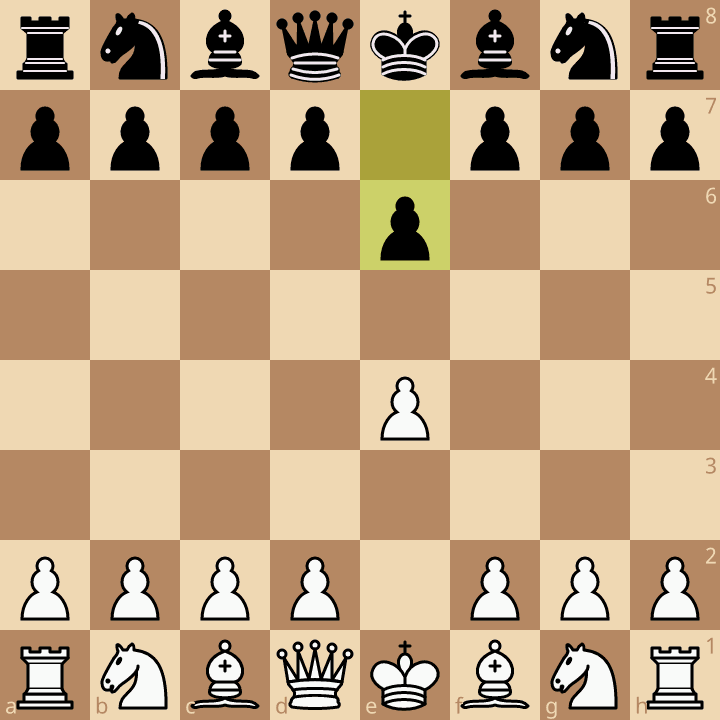
1.e4 e6
The French Defence is one of the most respected and resilient openings against 1.e4. By playing 1…e6, Black prepares the central pawn break …d5, challenging White’s centre while maintaining a solid pawn structure. Unlike Open Games, the French Defence often leads to closed or semi-closed positions where long-term planning is more important than immediate tactical attacks.
After 2.d4 d5, White usually chooses between advancing the pawn, exchanging in the centre, or defending the e4-pawn. Black often accepts a temporarily passive light-squared bishop in exchange for a strong central structure and excellent counterattacking opportunities. The resulting pawn chains create clear strategic plans for both sides. White generally attacks on the kingside, while Black seeks counterplay on the queenside and in the centre.
The French Defence has been played successfully by many World Champions because it offers excellent defensive resources while still providing opportunities to seize the initiative at the right moment.
Lesson: The French Defence demonstrates that a solid pawn structure and patient planning often outweigh immediate activity. Understanding pawn chains is the key to mastering this opening.
Example 3 – Caro-Kann Defence
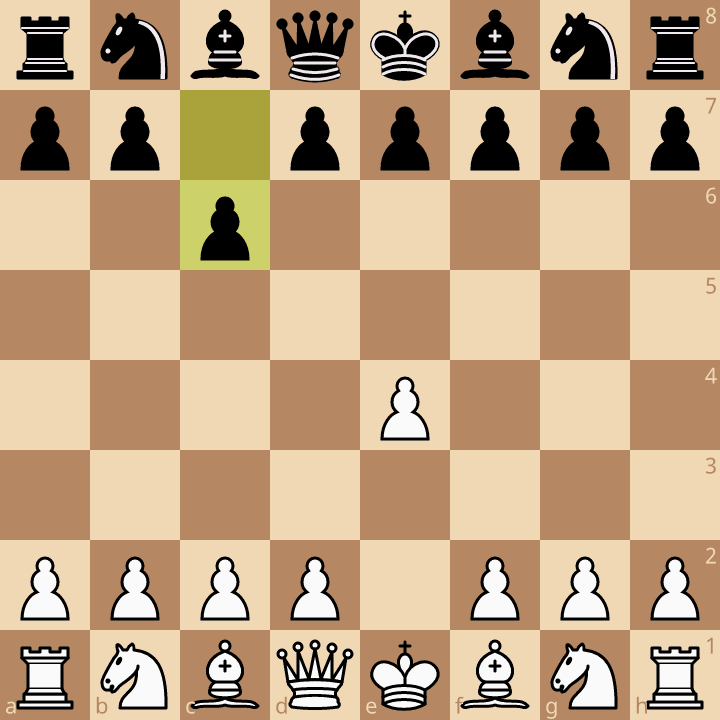
1.e4 c6
The Caro-Kann Defence is one of the soundest openings against 1.e4. Black prepares the central break …d5 while keeping the light-squared bishop free to develop before the pawn chain is established. This small difference from the French Defence gives Black a more flexible and harmonious position.
Following 2.d4 d5, both players fight for the centre while developing their pieces naturally. The Caro-Kann is known for its solid pawn structure, excellent endgame prospects, and relatively low tactical risk. Although it may appear quiet, the opening offers plenty of opportunities for active play once development is complete.
The Caro-Kann has been trusted by World Champions such as Anatoly Karpov, Viswanathan Anand, and Magnus Carlsen, proving its reliability at every level of chess.
Lesso: The Caro-Kann teaches that good piece development and a healthy pawn structure create long-term advantages. Patience and accurate positioning are often rewarded.
Example 4 – Alekhine Defence
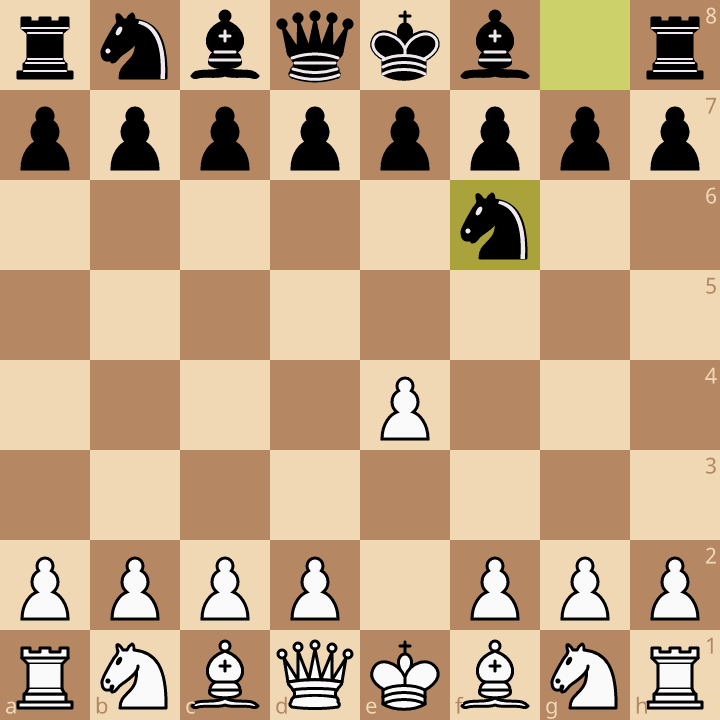
1.e4 Nf6
The Alekhine Defence is an unconventional opening named after former World Champion Alexander Alekhine. Instead of occupying the centre, Black immediately attacks White’s e4 pawn and encourages White to advance the central pawns. The idea is simple: allow White to build an impressive pawn centre, then undermine it with timely counterattacks.
After 2.e5 Nd5, White gains space, but Black intends to challenge the advanced pawns with moves such as …d6, …c5, and …Nc6. The resulting positions are often dynamic and require accurate positional judgement. Players using the Alekhine Defence must be comfortable playing slightly cramped positions before launching counterplay.
Because the opening breaks many traditional rules, it is often used as a surprise weapon against opponents who prefer quiet, classical positions.
Lesson: The Alekhine Defence teaches that allowing your opponent space can be part of a long-term strategy. A strong centre is valuable only if it can be maintained.
Example 5 – Pirc Defence
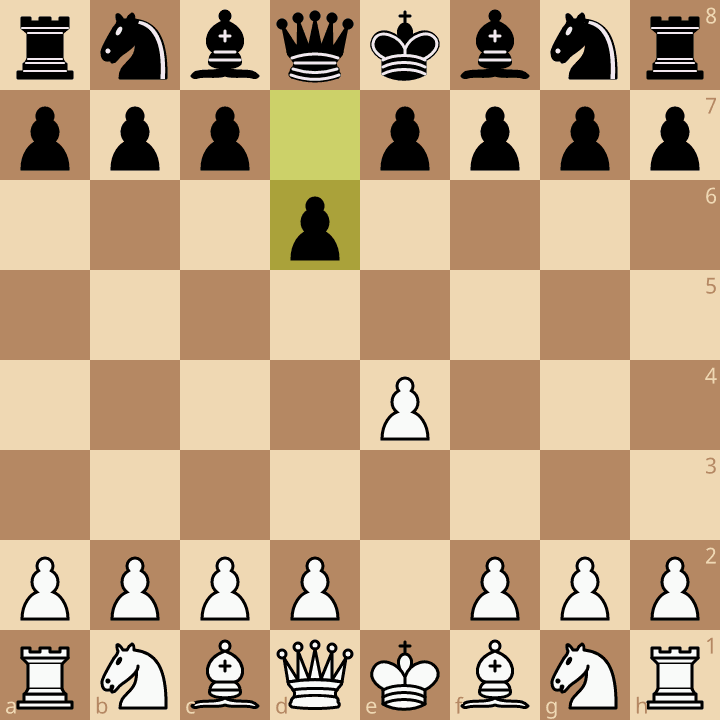
1.e4 d6
The Pirc Defence is a modern opening that allows White to occupy the centre before Black begins a counterattack. Rather than contesting the centre immediately, Black develops flexibly with …Nf6 and …g6, preparing to fianchetto the king’s bishop and place pressure on White’s central pawns.
The Pirc often leads to rich and unbalanced middlegames where both players have attacking chances. White usually enjoys more space, while Black relies on piece activity and timely pawn breaks such as …e5 or …c5 to challenge the centre. Because the opening avoids early confrontation, it rewards players with strong strategic understanding and patience.
The Pirc Defence is popular among players who enjoy dynamic positions and are comfortable defending slightly passive setups before launching counterplay.
Lesson: The Pirc Defence demonstrates that controlling the centre with pieces can be just as effective as occupying it with pawns. Flexibility is often one of the greatest strengths in chess.
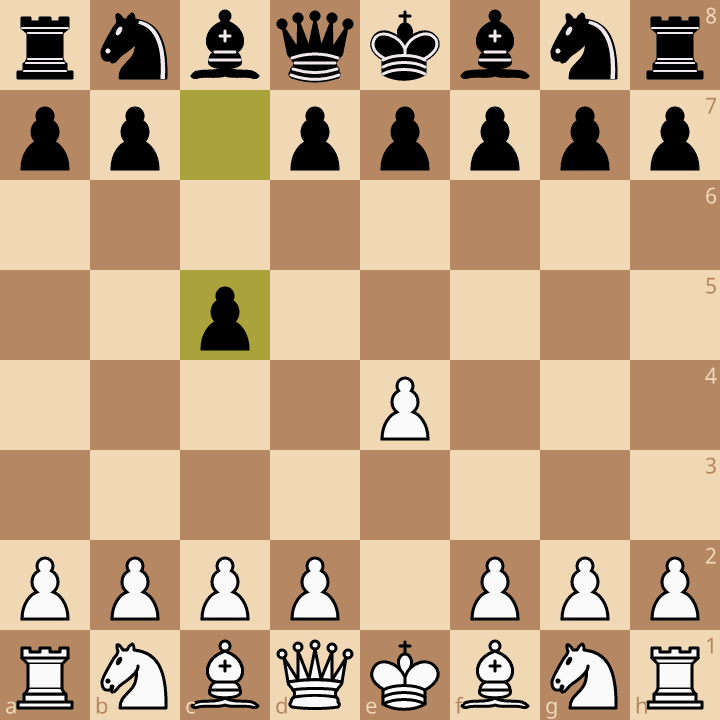
Example 6 – Sicilian Defence
1.e4 c5
The Sicilian Defence is the most popular and dynamic response to 1.e4. Rather than mirroring White’s central pawn with …e5, Black immediately attacks the d4 square and creates an asymmetrical pawn structure. This imbalance often leads to exciting positions where both players have opportunities to play for the win.
After 2.Nf3 and 3.d4, Black exchanges the c-pawn for White’s central pawn, opening the c-file for rook activity while maintaining excellent counterplay. The Sicilian has numerous variations, including the Najdorf, Dragon, Classical, Scheveningen, and Accelerated Dragon, each with its own strategic ideas and tactical themes.
Because of its complexity and fighting nature, the Sicilian Defence has been the preferred weapon of countless World Champions, including Bobby Fischer, Garry Kasparov, and Magnus Carlsen. It remains one of the most heavily analysed openings in modern chess.
Lesson: The Sicilian Defence teaches that imbalanced positions create winning chances for both sides. By combining active piece play, central counterplay, and dynamic pawn structures, Black can fight for the initiative from the very beginning of the game.
From the Editor
Semi-Open Games begin with 1.e4, but instead of replying with 1…e5, Black chooses an alternative defence such as the Sicilian, French, Caro-Kann, Scandinavian, Alekhine, or Pirc. These openings may look very different from one another, but they all share a common goal: challenge White’s central control in unique and dynamic ways.
As you study these openings, don’t try to memorize dozens of variations. Focus on understanding the strategic ideas behind each defence. Ask yourself: Why did Black choose this pawn structure? Which squares are being controlled? What are the typical plans for both sides? Once you understand these concepts, you’ll be able to navigate unfamiliar positions with confidence instead of relying on memory.
Semi-Open Games introduce a wide range of pawn structures, tactical motifs, and strategic battles that will greatly improve your overall chess understanding. Some, like the Caro-Kann, emphasize solid defence; others, like the Sicilian Defence, create sharp, unbalanced positions filled with attacking chances. Learning these openings will teach you how to adapt your style to different positions and opponents.
Remember, every strong defence begins with sound principles. Study the ideas, understand the plans, and let the moves become a natural consequence of your understanding.