
WCM DIVI BIJESH
A Champion Who Knows How To Finish
39th National Under-11 Girls Chess Championship 2026
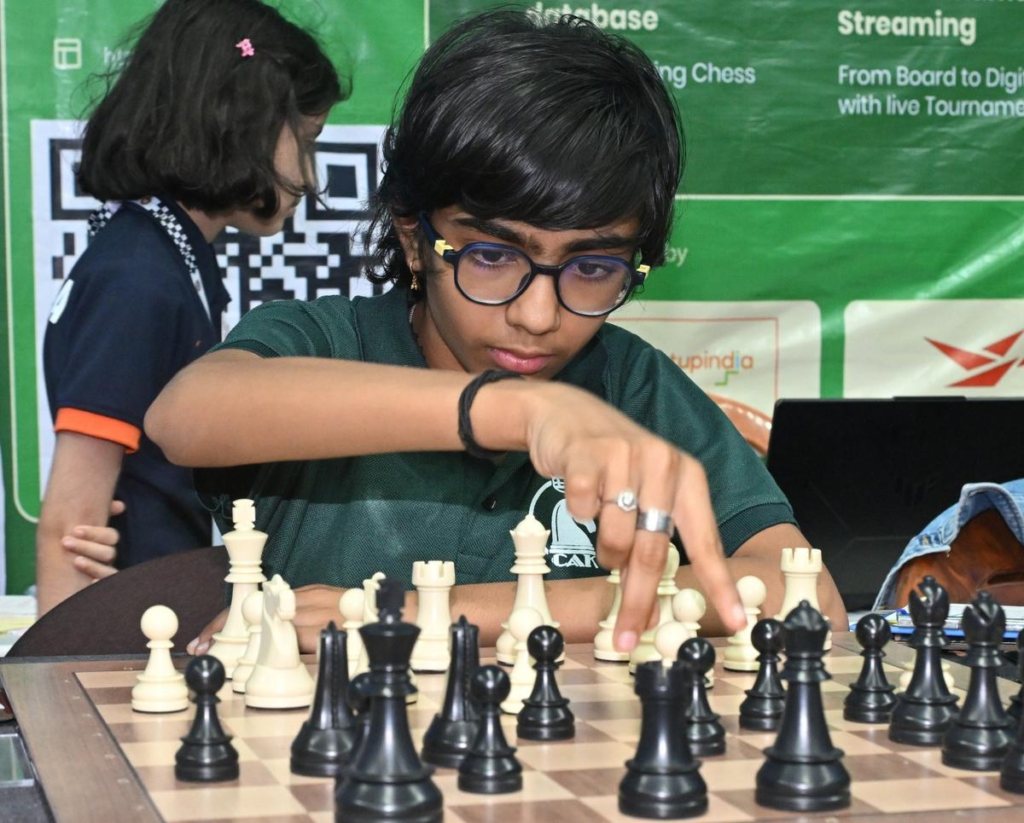
Divi Bijesh in action during the 39th National Under-11 Girls Chess Championship.
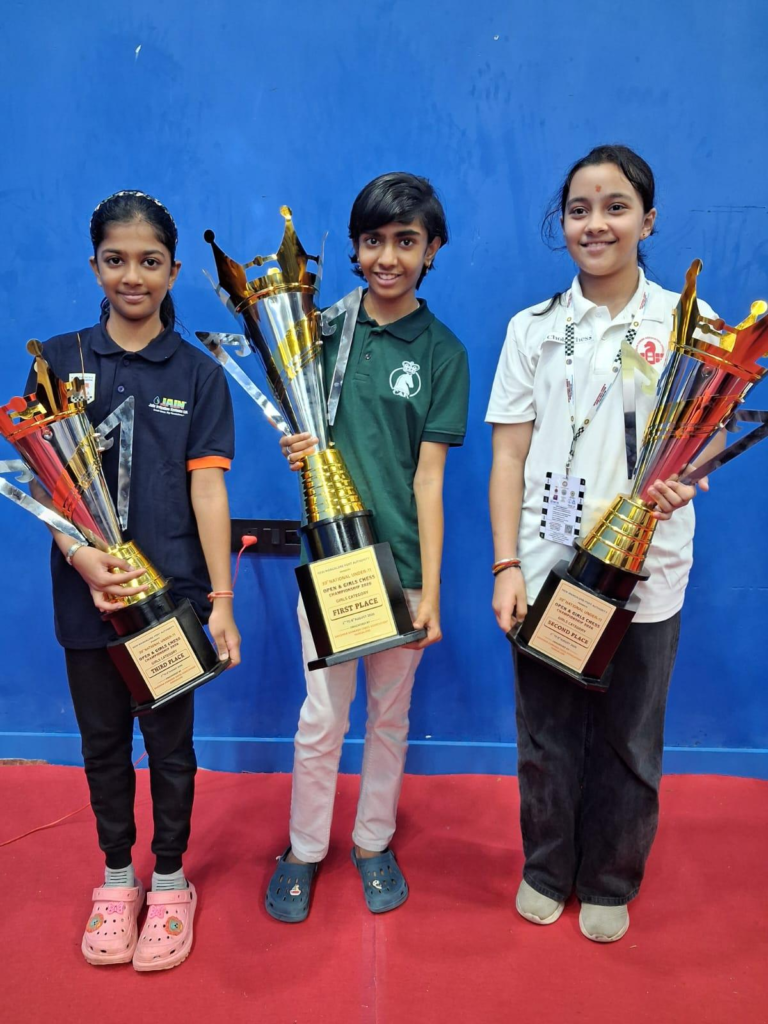
Divi Bijesh celebrates her National title alongside the silver and bronze medallists.
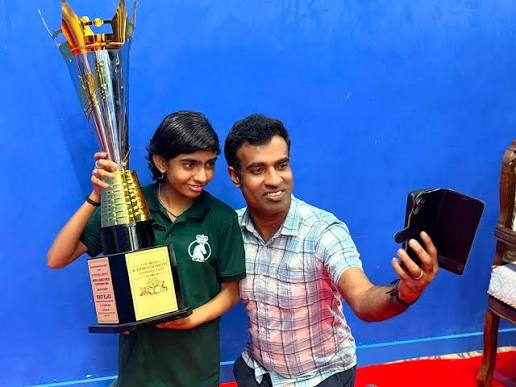
Divi Bijesh with the championship trophy after securing the Under-11 Girls title.
The Return to the Top
Some championships are won by starting brilliantly.
Others are won by surviving the difficult moments.
And then there are championships where a player does both — plays strong chess throughout the event and delivers when the title is finally within reach.
WCM Divi Bijesh did exactly that in Mangaluru.
The Kerala youngster emerged as the champion of the 39th National Under-11 Girls Chess Championship 2026, scoring an impressive 9.5 points from 11 rounds.
She finished half a point ahead of Vanshika Rawat, who took silver with 9/11, while Prisha Gholap completed the podium with 8.5/11.
But the score tells only part of the story.
Across the championship, Divi demonstrated several important qualities of a developing elite player: tactical awareness, active piece play, confidence in long games, understanding of passed pawns and, perhaps most importantly, the ability to convert advantages when the pressure is highest.
The final round provided the perfect example.
With the championship at stake, Divi defeated Nakshatra Gumudavelly and finished the tournament as National Champion.
She didn’t just reach the top.
She knew how to finish the climb.
The Championship: Eleven Rounds for One Crown
The 39th National Under-11 Girls Chess Championship brought together many of India’s strongest young female players for eleven rounds of classical chess.
With a 90 minutes + 30 seconds increment time control, the championship demanded much more than tactical sharpness. Players had to manage long games, conserve energy, calculate accurately and maintain concentration across an entire week.
For young players, this is an important part of development.
A junior championship is not simply a test of opening knowledge.
It tests how well a player can handle the complete chess day — preparation, calculation, time management, endgames and recovery between rounds.
Divi entered the event as one of the leading contenders and eventually separated herself from the field with a 9.5/11 score.
The battle for the podium remained competitive throughout.
The Final Podium
🥇 WCM Divi Bijesh — Gold — 9.5/11
🥈 Vanshika Rawat — Silver — 9/11
🥉 Prisha Gholap — Bronze — 8.5/11
The margins were small.
Just one point separated gold from bronze.
That makes Divi’s consistency even more significant.
The Champion: WCM Divi Bijesh
Divi Bijesh is already an established name in Indian junior chess.
Her strength is not based on one particular type of position.
She can play dynamically when the position demands it, but she is equally comfortable entering long games where patience and technique become more important than immediate tactics.
That versatility was visible throughout the championship.
The five games selected for this article show five different aspects of her play:
technical conversion, attacking preparation, endgame technique, passed-pawn play and championship pressure.
They also reveal something important about Divi’s development.
She is not simply looking for tactical shots.
She is learning how to build positions where those tactical opportunities eventually appear.
Five Games That Tell the Story
Rather than selecting five victories simply because they were wins, these games have been chosen because each demonstrates a different element of Divi’s chess.
#1 — Aadya Deo vs Divi Bijesh, Round 1
Winning the Battle of Patience
The championship began with Divi playing Black against Aadya Deo. The opening quickly became dynamic, beginning with: 1.Nf3 d5 2.g3 Nf6 3.Bg2 e6 4.O-O Be7 5.d4 O-O and White’s ambitious f4 soon changed the character of the position.
The queens were exchanged relatively early: 12.Qd5+ Qe6 13.Qxe6+ Kxe6. Black was left with an exposed king, but Divi understood that king safety was no longer the central issue. With the queens gone, activity and pawn structure became more important.
The game developed into a long technical battle. Divi activated her rooks, improved her king and eventually created a dangerous kingside passed pawn. The move 23…Rd3! was particularly instructive: instead of defending passively, Black activated the rook and created counterplay.
The final phase became a pawn race. After: 39…h3 40.Kxa7 h2 41.Kxb6 h1=Q. Black’s h-pawn promoted first, and the new queen soon delivered mate.
The Lesson
- A long endgame often comes down to one question:Which pawn race is actually faster?
- Divi did not panic when the kings entered the opponent’s territory. She calculated the promotion race accurately and trusted her active pieces and passed pawn.
- Good endgame technique is not about moving slowly. It is about calculating accurately before you commit
#2 — Divi Bijesh vs Narayani Umesh Marathe, Round 6
Building the Attack Step by Step
This game showed a completely different side of Divi’s chess. She began with: 1.e4 d5 2.exd5 Qxd5 3.Nc3 immediately gaining a tempo against Black’s queen.
Instead of rushing into an attack, Divi developed her pieces and gradually prepared a kingside expansion. The move: 10.h4 was an important signal. White intended to gain space and create attacking possibilities, but the position still required patience. After the queens were exchanged, Divi’s active pieces became increasingly important.
The sequence: 24.e6 Nf5 25.exf7+ Kh8 26.Be6! created serious problems for Black. The advanced f-pawn restricted the king while White’s pieces became more active. Then came: 31.Rxh6! and the attack accelerated.
The final sequence: 37.Nf6+ Kd8 38.Nxd5 Rf8 39.Rc8# was a clean demonstration of coordination. The final checkmate was not an isolated tactical trick. It was the result of several moves spent improving the position.
The Lesson
- Strong attacks are usually constructed, not discovered.
- First create space. Then activate the pieces. Then restrict the king.
- Only after that look for the tactical finish.
- Divi followed that sequence almost perfectly.
#3 — Divi Bijesh vs Kiyanna Parihaar, Round 8
The Art of Conversion
If one game best demonstrates Divi’s technical side, this is it. The opening was relatively quiet: 1.Nf3 d5 2.g3 Nf6 3.Bg2 e6 4.O-O Be7
There was no immediate tactical explosion. Instead, Divi gradually improved her pieces and created central tension. The queens came off with: 15.Bc3 Qxc2 16.Rxc2 and the game entered a complicated position where piece activity became more important than opening theory.
Divi’s pieces became increasingly active, particularly her knight and rook. The sequence: 31.Nd6 d3 32.Nxb5 was a good example of creating counterplay instead of simply defending against the opponent’s passed pawn.
Eventually, the game reached a pure king-and-pawn phase. And this is where Divi demonstrated excellent technique.
Her king became an active fighting piece: 54.Kf5 55.Ke6 while her pawns advanced together.
The game ended with: 59.g7#
The Lesson
- In many endgames, the king is the strongest piece on the board.
- Divi understood when the tactical phase was over and when the king needed to take responsibility.
- Activate your king, calculate pawn races and make sure every pawn move has a purpose.
#4 — Divi Bijesh vs Yakshini P, Round 10
When a Passed Pawn Becomes a Weapon
By Round 10, the tournament was approaching its decisive phase.
Divi began quietly: 1.Nf3 Nf6 2.g3 e6 3.Bg2 d5 4.O-O But gradually, she started gaining space on the queenside.
The sequence: 14.b4! 16.c5 17.b5 created a dangerous pawn structure.
The key move came with: 21.c6! Now the c-pawn became a major problem for Black.
Black’s pieces were forced to respond to the promotion threat, while Divi’s remaining pieces gained freedom.
Even after the queens were exchanged, the danger remained.
The a-pawn advanced: 33.a7 and eventually: 38.a8=Q. White promoted.
The newly created queen then joined the attack, and the game concluded with: 48.Qf7#
The Lesson
- A passed pawn does more than threaten promotion.
- It can tie down the opponent’s pieces.
- Once your opponent is forced to spend their resources stopping the pawn, your other pieces become more powerful.
- Divi converted that principle into a direct attack.
#5 — Divi Bijesh vs Nakshatra Gumudavelly, Round 11
The Championship Game
This was the game that mattered most. The final round. The title at stake. And Divi had to finish the tournament against another strong player.
She opened with the Ruy Lopez: 1.e4 e5 2.Nf3 Nc6 3.Bb5. The early middlegame was strategically rich. Rather than forcing tactics immediately, both sides manoeuvred their pieces and prepared their central breaks. Divi eventually played: 15.d4 and after: 17.d5. she gained space and restricted Black’s pieces. The attack gradually shifted toward the kingside. Divi’s queen and pawns became increasingly active: 27.Qf3 28.g4 30.f6
The advanced f-pawn created immediate tactical possibilities. After: 31.Bxg6 fxg6 32.f7+. Black was forced to deal with the advancing pawn. The queens were eventually exchanged, but Divi had already achieved the more important objective: her rooks were active and Black’s position was tied down.
The rook invasion began with: 36.Ra7+ and continued with: 41.Rxg7 and: 46.Rxd6 47.Rcc6 48.Rxf6. The final sequence was decisive: 51.Rc7+ Kg8 52.Rd8#.
Checkmate. And with it, Divi became the 2026 National Under-11 Girls Champion.
The Lesson
- The final round of a tournament is not the time to play a different game.
- The temptation is to become overly cautious because the result matters.
- Divi did the opposite. She played actively, improved her pieces, created weaknesses and converted the advantage.
- Champions don’t just create winning positions. They know how to finish them.
Performance: 9.5/11 and Back on Top
Divi finished the championship with an outstanding 9.5 points from 11 rounds.
That means she dropped only 1.5 points across the entire championship, finishing half a point ahead of silver medallist Vanshika Rawat.
The score is impressive.
But the manner of the victories is even more interesting.
Across the five games analysed here, Divi demonstrated:
Tactical Awareness: She consistently recognised tactical opportunities once her pieces were properly placed.
Active Piece Play: Her rooks repeatedly became decisive attacking pieces once positions opened up.
Passed-Pawn Understanding: The Aadya Deo and Yakshini P games showed how effectively she understands pawn races and promotion threats.
Endgame Technique: Against Kiyanna Parihaar, Divi demonstrated patience and excellent king activity in a long technical battle.
Attacking Coordination: Against Narayani, she built the attack gradually rather than relying on one tactical shot.
Pressure Management: Most importantly, she delivered in Round 11 when the championship was at stake.
That combination is encouraging.
A junior player does not need to have every part of the game completely developed.
What matters is whether the foundations are strong enough to support continued improvement.
Divi’s chess already shows several of those foundations.
The Road Ahead
Winning a National Championship at Under-11 level is a significant achievement.
But for Divi Bijesh, the title should not be viewed as an endpoint.
It is another milestone in a much longer journey.
The next stage will bring stronger opponents, more international competition, increasingly sophisticated opening preparation and positions where tactical ability alone will not be enough.
The challenge will be to keep developing the less visible parts of the game: calculation, positional understanding, endgame technique, opening preparation, time management and psychological resilience.
And perhaps the most important lesson from this championship is already visible in her results.
She knows how to respond.
She has experienced the pressure of competing at the top.
She has experienced the disappointment of falling short.
And she has now returned to the National podium as champion.
That ability to learn, adapt and come back stronger will matter far more than any single trophy.
A Champion Again
The 39th National Under-11 Girls Chess Championship produced a closely contested podium.
Divi Bijesh — 9.5/11
Vanshika Rawat — 9/11
Prisha Gholap — 8.5/11
Three players separated by just one point.
But the gold belonged to Divi.
Her championship was not built around one spectacular game.
It was built across eleven rounds.
And the five games examined here reveal why she deserved the title: she can calculate, attack, defend, play long endgames, use passed pawns and — when the moment arrives — convert.
The final round was perhaps the most fitting conclusion.
Divi did not wait for the championship to come to her.
She played for the win.
She found the right moments.
She brought her rooks into the position.
And then she delivered checkmate.
9.5/11. National Champion.
For now, Divi Bijesh is India’s Under-11 Girls Champion.
The more interesting question is what she will become next.
The road ahead has only just begun.