
FM SARBARTHO MANI
A New National Champion Emerges
39th National Under-11 Open Chess Championship 2026
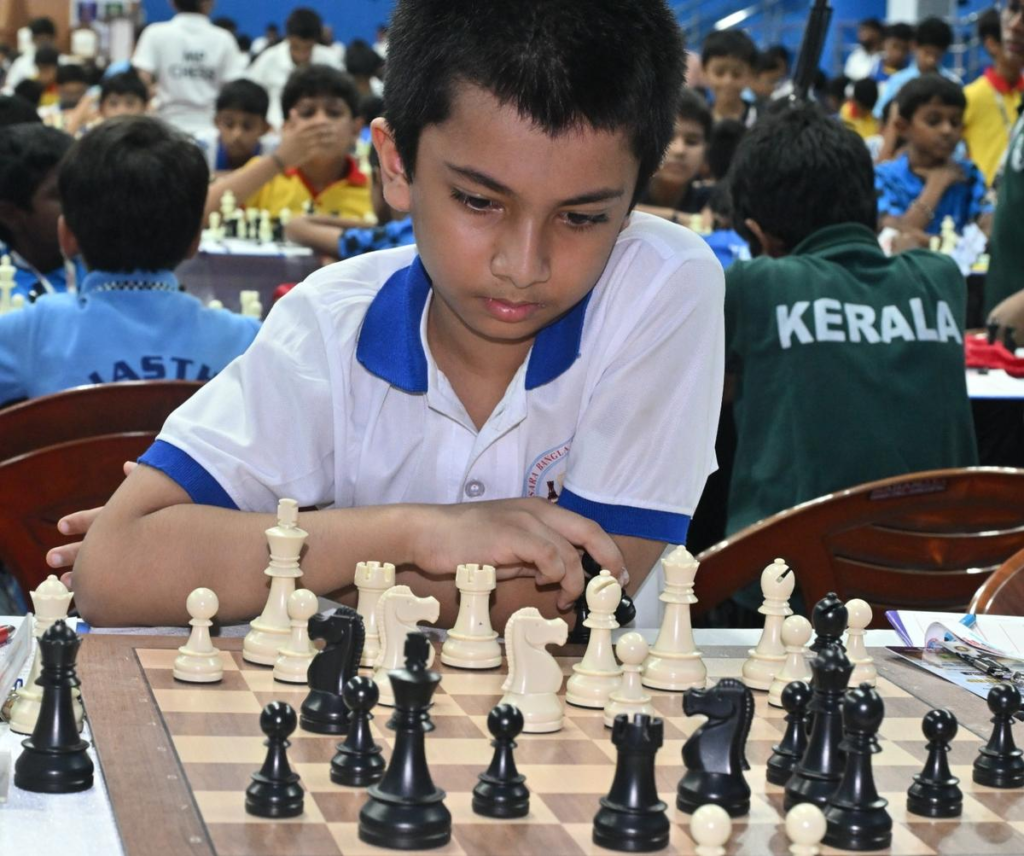
FM Sarbartho Mani in action during the 39th National Under-11 Open Chess Championship.
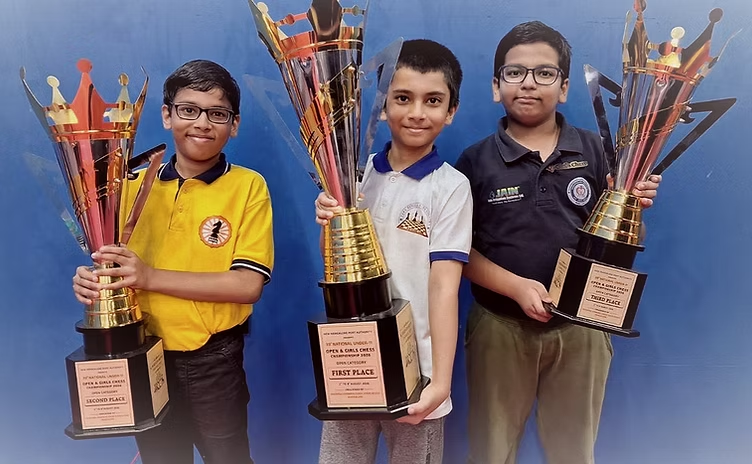
Sarbartho Mani celebrates his National title alongside the other podium finishers.
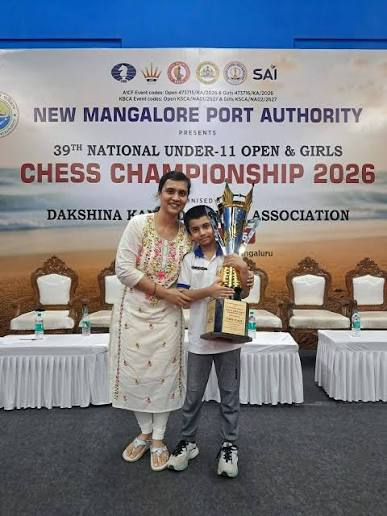
Sarbartho receives the championship trophy after winning the 39th National U-11 Open title.
The Rise to the Top
Some national titles are unexpected breakthroughs.
Others feel like the natural next step in a player’s development.
For FM Sarbartho Mani, the 39th National Under-11 Open Chess Championship was the latter.
The West Bengal youngster entered the tournament as the second seed with a rating of 2273, behind FM Advik Amit Agrawal, and faced a strong field that included Nidhish Shyamal, CM Sattwik Swain, Oishik Mondal, CM Divith Reddy Adulla and several other leading Indian juniors.
By the end of eleven rounds in Mangaluru, Mani had done much more than win the title.
He had scored an outstanding 10.5/11, finishing a full point ahead of silver medallist CM Sattwik Swain and 1.5 points ahead of FM Advik Amit Agrawal, who took bronze.
But the number only tells part of the story.
Mani’s championship was built on a remarkable combination of calculation, activity, tactical awareness and practical decision-making.
And this National title comes after an already impressive international journey.
The Championship: Eleven Rounds, One Clear Winner
The 39th National Under-11 Open Championship brought together India’s strongest young players for eleven rounds of classical chess.
For a player at this level, winning a national championship is rarely about one brilliant game.
It requires the ability to handle different opponents, different openings, changing tournament situations and the inevitable moments of pressure that appear during a long event.
Mani proved capable of all of them.
His tournament included attacking victories, technical endgames, tactical counterplay and even a strategically mature draw against one of the tournament’s strongest contenders.
And when the final round arrived, he finished the job himself.
Playing Black against Devanarayanan Kalliyath, Mani converted his advantage into a decisive victory and secured the championship with 10.5/11.
The Podium
🥇 FM Sarbartho Mani — Gold — 10.5/11
🥈 CM Sattwik Swain — Silver — 9.5/11
🥉 FM Advik Amit Agrawal — Bronze — 9/11
The final margin was significant.
Mani finished one full point clear of second place and 1.5 points ahead of third.
That is the kind of score that leaves very little room for doubt.
The Champion: Sarbartho Mani
Sarbartho Mani’s National title is not an isolated achievement.
His progress has been visible on the international stage for some time.
In 2025, Mani won the FIDE World Cup Under-10 in Batumi, Georgia, defeating compatriot Oishik Mondal in the rapid tiebreaks after their two classical games were drawn.
Later that year, he won bronze in the Under-10 Open at the World Cadet Chess Championship in Almaty, scoring 8.5/11.
In 2026, he added another international medal, taking silver in the Under-10 Open at the FIDE World Cup Cadets in Batumi, again scoring 8.5/11.
That makes the National Under-11 title an important continuation of a pattern.
Mani has already shown that he can perform internationally.
Now he has dominated the strongest field in his own age category at home.
Five Games That Tell the Story
Rather than simply choosing five victories, these games reveal different parts of Mani’s chess. Together they show a player who is comfortable attacking, calculating, defending, simplifying and converting.
#1 — Aadwik Abhinav Krishna vs Sarbartho Mani, Round 5
Patience Before the Finish
This was one of the most instructive games of Mani’s championship because the decisive work came long after the opening. Mani began with a flexible Réti setup and gradually transformed the position into a Queen’s Gambit-type structure.
After 16…c4, Black gained queenside space, but Mani did not rush into complications. Instead, he patiently improved his position.
The sequence: 25.Bd2 c3 26.bxc3 bxc3 27.Bxc3 removed Black’s dangerous passed pawn and allowed the queens to come off with 28…Qxf2+ 29.Kxf2. Now the game became a technical battle.
Mani activated his king while his rooks repeatedly invaded the seventh and eighth ranks. The sequence 37.Rb5, 38.Rxd5 and 43.f6 showed excellent coordination between rook and pawn.
The final phase was particularly impressive. After 68.f7 Re2, Mani did not automatically promote to a queen. Instead: 69.f8=N+!
An underpromotion with check. The game ended shortly afterwards.
The Lesson
- In difficult endgames, don’t focus only on material.
- Activate your king, improve your pieces and keep creating problems.
- Sometimes the winning idea appears only after several precise moves.
#2 — Devansh Keshri vs Sarbartho Mani, Round 7
Pressure Without Panic
This game demonstrates a very practical tournament skill: playing against the clock without losing control of the position.
Mani developed his pieces actively and prepared the central break e4.
The move 18.Bxa6 was useful because it removed a pawn and forced Black’s rook onto a less comfortable square. The critical phase came after: 25.e4 fxe4 26.fxe4
Mani’s central pawns became increasingly powerful while Black’s clock began to collapse.
After 27.Bxd4, Mani simplified while keeping the initiative. The sequence 29.Ne3, 30.Nc4 and 31.Qxc4 removed Black’s remaining active knight.
By move 34, Black had little more than a minute.
But Mani did not start forcing tactics simply because his opponent was in time trouble. Instead, he continued to make useful moves: 35.Rd7+ 36.Qxc5 37.Bd4
Even when Black generated checks, Mani kept his king safe and maintained control.
The Lesson
- When your opponent is short of time, don’t become impatient.
- Keep making strong moves.
- Pressure works best when you don’t rush.
#3 — Sarbartho Mani vs Varchas Krishna Jayaraman, Round 8
Counterattack Beats Overextension
This was perhaps Mani’s most tactically interesting victory.
The game began with a sharp Sicilian Defence. White immediately chose an ambitious route with 6.Ndb5 and 7.Nd6+, forcing the black king to e7.
Mani’s response was not passive. Instead, he played 8…e5, challenging White’s advanced pieces and beginning to create counterplay.
As the position developed, Mani coordinated his queen, rook and knight against White’s exposed king.
The sequence beginning with 25…Qxc3 was particularly important.
Mani’s queen became extremely active, entering with checks and forcing White’s pieces into defensive positions.
The final combination was elegant: 46…Nxg1! After: 47.Rxg1 Qxe3 48.Bxc4 Qf3+
Mani emerged with decisive advantages and converted the position cleanly.
The Lesson
- An exposed king is not automatically a weakness for the attacking side.
- If you can create counterplay quickly enough, the opponent’s attack can become your attacking resource.
#4 — FM Advik Amit Agrawal vs Sarbartho Mani, Round 9
Knowing When to Neutralise
Not every important tournament game needs to end in victory. This was one of Mani’s most important games from a competitive perspective because he faced FM Advik Amit Agrawal, the higher-rated top seed and one of the tournament’s leading contenders.
The position became tactically complicated after: 9.d5 Nxd5 10.cxd5 Bxc3
White immediately exploited the tactical possibilities with 11.Bh6, followed by a sequence involving 12.Nxe5, 13.Bxf8, 14.Bxe7 and 15.Qxa1.
The resulting position was materially unusual, but Mani maintained active piece play.
The exchange sequence beginning with 21.Rxc8+ simplified the position.
After 23.Bxb7 Qxb7, the game entered a quieter phase. From move 25 onward, neither player wanted to create unnecessary risk.
The game was eventually agreed drawn after 30…Kg8.
For Mani, holding the tournament’s top seed to a draw was a valuable result.
The Lesson
- Strong tournament chess is not always about winning.
- Sometimes the correct decision is to neutralise a dangerous opponent, protect your tournament position and move forward.
#5 — Sarbartho Mani vs Devanarayanan Kalliyath, Round 11
Finishing Like a Champion
Every championship story needs a final chapter. For Mani, this was it.
With the title within reach, he faced Devanarayanan Kalliyath in the final round. The opening was quiet. Mani developed through a Réti structure with Nf3, e3, c4, Nc3 and b3, gradually preparing the central break: 15.e4
After 15…dxe4 16.Nxe4, White had active pieces while Black was already spending considerable time. The critical phase began with: 18.d5. Black tried to simplify with 18…Nxe4, but Mani calculated the exchange sequence accurately: 19.Rxe4 Rxe4 20.Bxe4
He then removed another dangerous piece with 22.hxg4. The most instructive moment came with: 25.g5. After Black’s bishop moved to e5, Mani immediately opened the f-file: 26.gxf6
Black responded with 26…Bxd4, apparently winning the queen. But Mani had seen the point. 27.fxe7! The pawn reached e7 with decisive consequences, and Black could no longer prevent the position from collapsing.
The victory gave Mani 10.5/11 and confirmed him as National Champion.
The Lesson:
- A passed pawn becomes especially dangerous when it advances with tempo.
- Always ask: What tactical threats does my promotion threat create?
- Sometimes the pawn does not need to promote.
- The threat of promotion is enough to win the game.
Performance: From Fifth Place to National Champion
The most interesting part of Mani’s National title may not be the 10.5/11 score.
It is the progression.
In the previous National Under-11 Championship in 2025, Mani finished fifth with 8.5/11, behind champion Aarit Kapil.
One year later, he returned to the same championship.
This time, he did not merely improve his position.
He won it.
His recent international results provide further context:
- 2025 FIDE World Cup U10 — Gold
- 2025 World Cadet Championship U10 — Bronze
- 2026 FIDE World Cup Cadets U10 — Silver
- 2026 National Under-11 Open — Gold
That sequence tells us something important.
Mani’s development is not dependent on one tournament.
He has repeatedly performed against strong opposition, both internationally and domestically.
And the National Championship showed that his international experience is beginning to translate into consistency over a full eleven-round national event.
The Road Ahead
A National Championship at Under-11 level is a major achievement.
But for Mani, it should be viewed as another milestone rather than a destination.
The next challenge will be considerably harder.
He will face stronger opposition, more experienced players and increasingly sophisticated opening preparation. The positions will become more complex, and small inaccuracies will carry greater consequences.
His next stage of development will therefore be about more than winning junior tournaments.
He will need to continue improving his: calculation, positional understanding, endgame technique, opening preparation, time management and practical decision-making.
The encouraging part is that many of these qualities are already visible in his chess.
The five games examined here show that he can win technical endings, play under time pressure, counterattack an exposed king, neutralise a dangerous opponent and finish a championship with a tactical victory.
That is a very good foundation.
A New National Champion Emerges
Sarbartho Mani’s journey through the 39th National Under-11 Open Championship was not simply a story of one tournament.
It was a story of progression.
He arrived as the second seed.
He left as National Champion.
He finished with 10.5/11, one point clear of Sattwik Swain and 1.5 points ahead of Advik Amit Agrawal.
More importantly, he demonstrated the ability to win in different ways.
There was patience in the endgame.
Calculation under pressure.
Counterattacking instinct.
Tournament judgment.
And finally, the tactical precision required to finish the championship.
A year after finishing fifth, Mani returned to the same event and went all the way.
He didn’t simply arrive as a champion.
He came back and improved.
For now, FM Sarbartho Mani is the 39th National Under-11 Open Champion.
And with international medals already behind him and a National title now added to the résumé, the more interesting question is no longer whether he can compete at the top of his age group.
It is how far he can go beyond it.
The road ahead has only just begun.