
DIBYENDU BARUA
The Pioneer Who Proved India’s Chess Revolution Was Real
Snapshot
- Born : 27 October 1966
- State : West Bengal
- FIDE ID : 5000025
- Grandmaster Year : 1991
- Peak Rating : 2561 (July 2003)
- Awards : Arjuna Award (1983)
Gallery

A fearless young Barua emerging on the Indian chess scene.
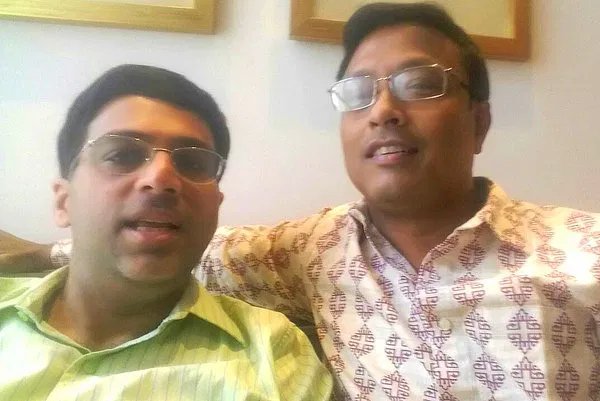
Two pioneers who helped shape modern India’s chess story.
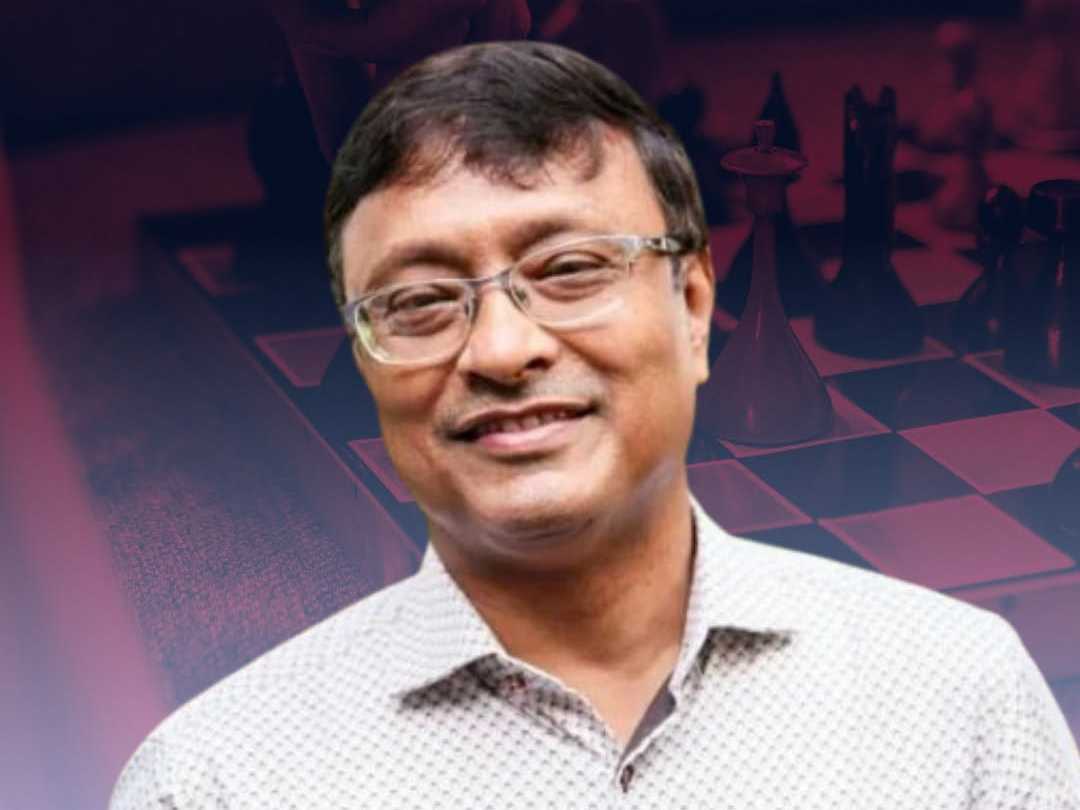
A Grandmaster who helped build the foundation for India’s chess revolution.
Before the Chess Boom, There Was Barua
Long before India became a global powerhouse in chess, a young boy from Kolkata was already capturing the imagination of Indian chess.
His name was Dibyendu Barua.
At a time when Indian chess had little financial backing, limited access to international tournaments and none of the technology available to today’s players, Barua developed through talent, instinct and an uncompromising competitive spirit.
As a 12-year-old, he became the youngest participant in the history of the Indian National ‘A’ Championship in 1978.
It was an early sign of what was to come.
Barua played with courage. He was willing to take risks, enter complicated positions and challenge established players without hesitation.
Years before India’s chess renaissance gathered momentum, Barua was already proving that Indian players could compete with — and defeat — the world’s best.
If Anand opened the door to modern Indian chess, Barua helped prove that the revolution was real.
The Young Champion
Barua’s rise began remarkably early.
In 1983, while still a teenager, he won the Indian National Championship. It was the first of three national titles that would eventually span three different decades.
The achievement was significant not simply because of his age, but because of the environment in which it happened.
There were no chess engines guiding preparation. No online databases. No sophisticated training networks. International opportunities were limited, and financial support was often difficult to secure.
Yet Barua continued to compete.
His chess was characterised by courage and aggression. He was willing to enter complicated positions and challenge his opponents directly rather than waiting for opportunities to appear.
That fighting spirit would remain a defining feature throughout his career.
And while Anand’s emergence in the late 1980s would eventually transform Indian chess, Barua was already established as one of the country’s strongest players.
He was no longer simply a promising youngster from Kolkata.
He was becoming a national force.
The Final Step: Becoming India’s Second Grandmaster
When Viswanathan Anand became India’s first Grandmaster in 1988, a new possibility had been created.
But someone had to follow.
For Barua, the challenge was enormous. Talent alone was not enough. He needed international tournaments, strong opponents and opportunities to score the Grandmaster norms required for the title.
The breakthrough began in 1989, when Barua secured his first Grandmaster norm at the NatWest Trophy in London.
A year later, at the 1990 Novi Sad Olympiad, he earned his second norm and won an individual board gold medal.
Only one step remained.
The final norm came in January 1991, at the Duncan GM Tournament in Kolkata.
Playing in his hometown, Barua completed the journey.
In 1991, Dibyendu Barua officially became India’s second Grandmaster and the first Grandmaster from West Bengal.
It was a historic moment.
Anand had shown that an Indian could reach the world’s highest level.
Barua proved that Anand’s achievement was not an isolated miracle.
Indian chess had found another Grandmaster.
Five Games That Defined the Pioneer
Across these five games, Dibyendu Barua’s chess reflects the qualities that defined his career — fearless attacking play, active pieces, tactical calculation and a relentless fighting spirit.
From defeating Viktor Korchnoi and Veselin Topalov to producing powerful victories at the Olympiads, these games show a player who never allowed ratings or reputation to dictate how he played.
#1 – D. Barua vs. V. Korchnoi, Lloyds Bank Open, 1982, London
At just 15 years old, Dibyendu Barua faced one of the most formidable players of his era, Viktor Korchnoi, rated more than 250 points higher. What followed was an extraordinary display of fearless attacking chess.
Barua played the Italian Game and immediately fought for the centre with 14.d4 and 16.d5, gaining space while forcing Black’s pieces into uncomfortable positions.
The game became increasingly sharp. After 22.Ne3 g4 23.h4 gxf3 24.Rxf3, Korchnoi sacrificed material with 24…Rxg3, but Barua accepted the challenge with 25.Rxg3.
The real story of the game, however, was Barua’s passed d-pawn.
After 30.c5 dxc5 31.d6+, the pawn marched relentlessly forward.
The remarkable sequence 35.d7 cxb3 36.Qc5+ Ka8 37.dxc8=Q! saw Barua promote with check, forcing the exchange of queens and leaving him with a winning endgame.
Barua eventually converted the advantage and Korchnoi resigned after 54.e5.
The Lesson:
- A passed pawn can become a weapon stronger than material.
- Barua didn’t merely create the passed pawn — he pushed it relentlessly, forcing Korchnoi’s pieces into passive defence.
- Create a passed pawn, support it, and make your opponent stop it.
#2 – D. Barua vs. D. Johansen, Thessaloniki Olympiad, 1988
Just months after becoming India’s first Grandmaster, Viswanathan Anand had opened a new chapter for Indian chess.
Barua was still pursuing that same breakthrough, and at the 1988 Thessaloniki Olympiad, he produced a powerful attacking victory against Australia’s Darryl K. Johansen.
Playing the Scheveningen Sicilian, Barua gradually built pressure on the kingside before shifting his pieces toward Black’s weaknesses.
The manoeuvre 24.Nb5 followed by 25.Nd6 gave his knight an excellent outpost and forced Black into a difficult defence.
The critical phase began with 28.Qxe5, when Barua won a pawn and kept his pieces highly active. His passed e-pawn then became a major weapon.
After 33…Bxd6 34.exd6, the pawn reached d6, while Barua’s rooks invaded the seventh and eighth ranks. The sequence 35.Rc7 Rbd8 36.Rxd7 Rxd7 37.Rc8+ demonstrated excellent coordination.
Barua’s attack eventually became overwhelming, and after 40.Qxb7 Rxd6 41.Rxg7+, Johansen resigned.
The Lesson:
- Active pieces create threats that material alone cannot solve.
- Barua steadily improved his pieces, created a dangerous passed pawn and used his rooks to penetrate the seventh rank.
- Keep your pieces active, create targets, and let the pressure build.
#3 – D. Barua vs. V. Topalov, Biel Interzonal, 1993
This was another remarkable upset by Barua, who was rated around 160 points below Veselin Topalov. Playing White, Barua produced a direct attacking game against one of the strongest young players in the world.
The game began with the Sicilian Moscow Variation, and Barua gradually built his attack around the exposed black king. His queen and rooks were particularly active, with 19.Qh3, 23.Rh3 and 24.Rg3 creating increasing pressure on the kingside.
The decisive phase began with 25.f5!, opening lines against Black’s king. After 25…exf5 26.Nd5, Barua’s pieces became increasingly dangerous.
The final combination was swift:
28…bxc4 29.Qxf5+ Kg8 30.Bxg7
Topalov could not prevent the attack from becoming decisive and resigned.
What makes the victory especially impressive is the opponent. Topalov was rated 2670, while Barua was rated 2510 — yet Barua played with complete confidence and never allowed the rating difference to dictate the game.
The Lesson:
- Never let your opponent’s reputation influence your chess.
- Barua played Topalov as an equal, built his attack patiently and then struck when the position demanded it.
- The rating is on the scoreboard. The position is on the board. Play the position.
#4 – Aleksandar Wohl vs Dibyendu Barua, British Championship, Torquay, 2002
By 2002, Barua was an established Grandmaster, but this game showed that his fighting spirit had not diminished.
Playing Black against Aleksandar Wohl, Barua entered the French Defence and created immediate counterplay on the kingside. After 10…h5 11.c3 h4, Black began gaining space and driving White’s pieces away.
The position became tactical after White castled queenside. Barua’s attack accelerated with 23…h3!, followed by the striking 24…hxg2+. White’s king was increasingly exposed, while Barua’s rooks were perfectly placed for the attack.
The critical sequence came with: 27.Red1 Rdh8 28.Ne1 Rxh2+!
White accepted the sacrifice with 29.Qxh2, but Barua had calculated further: 29…Rxh2+ 30.Kxh2 Qe8
The rook sacrifice opened the h-file and left White’s king exposed to a relentless queen attack. Barua’s queen kept checking, while the bishop joined the attack.
After 35…Bb6 36.Rac1 Qg3, White had no defence and resigned.
The Lesson:
- When the king is exposed, activity can be worth more than material.
- Barua willingly sacrificed a rook to rip open the king’s position and then used his queen and bishop to maintain the attack.
- Calculate the attack beyond the sacrifice — the material may come later.
#5 – Dibyendu Barua vs Hugo Spangenberg, Yerevan Olympiad, 1996
Barua’s fifth game brings us back to one of his favourite battlegrounds: the Sicilian Defence.
Against Argentina’s Hugo Spangenberg, he entered the sharp Dragon Variation, Yugoslav Attack, where both sides immediately committed to an unbalanced fight.
The game became tactical with 15.Nxd6 exd6 16.Qxd6, as Barua opened lines and won material.
Rather than retreat, Black tried to generate counterplay against the white king with 17…Qg5+ and 18…Qxg2.
Barua remained calm. After the queens were exchanged with 19.Qg3 Qxg3 20.hxg3, the game transitioned into an endgame where his active rooks became the decisive factor.
The move 22.Rd7! placed the rook deep in Black’s position. Barua continued improving his pieces, bringing the second rook into the attack with 23.Re1 and 25.Re3.
The final phase was particularly instructive. After 31.Rxh7 Rxe4 32.Rf5+, Barua had created decisive threats and Spangenberg resigned.
The Lesson:
- Activity is often more valuable than material in an endgame.
- Barua’s rooks dominated the seventh rank, attacked weaknesses and kept Black’s king under pressure.
- Activate your pieces, invade the opponent’s position, and make every move create a threat.
The Builder of Bengal Chess
For Barua, becoming a Grandmaster was never going to be the end of the story.
He had experienced first-hand how difficult it was for talented Indian players to find opportunities, resources and structured training.
He wanted the next generation to have something he did not.
In September 2005, together with his wife, Women International Master Saheli Dhar, Barua established the Dibyendu Barua Chess Academy (DBCA) in Kolkata.
The academy began with just 22 students.
But Barua’s involvement went far beyond putting his name on the institution.
He became a hands-on mentor, spending hours analysing games, teaching young players and helping them understand the demands of competitive chess.
The academy went on to produce elite players, including Grandmasters Mitrabha Guha and Koustav Chatterjee, along with several International Masters.
Barua’s contribution also extended beyond his academy.
Through his leadership in West Bengal chess, he worked to expand tournament opportunities and make chess more accessible across the state, including to players outside Kolkata.
The boy who once travelled in search of opportunities was now helping create those opportunities for others.
The Chess of Dibyendu Barua
Barua’s chess was never built around playing it safe.
His style reflected the personality of the player himself — bold, ambitious and willing to take risks.
At a time when Indian players were still fighting for recognition on the international stage, Barua was prepared to enter complicated positions against established opponents.
He did not play as though he belonged beneath them.
He played as though he belonged across the board from them.
That attitude mattered.
Chess development is not only about producing strong players. It is also about creating the belief that competing with the world’s best is possible.
Barua’s generation helped establish that belief.
A Career Across Three Decades
Barua’s longevity is one of the most remarkable aspects of his career.
He won the Indian National Championship three times — first in 1983, then again in 1998, and finally in 2001.
Those victories came across three different decades, reflecting his ability to remain competitive as Indian chess evolved.
He also represented India at eight consecutive Chess Olympiads from 1988 to 2002, becoming an important part of the national team’s development during a foundational period for Indian chess.
His career bridged two eras.
He belonged to the generation that had to fight for opportunities abroad, while also becoming part of the generation that helped make international chess increasingly accessible to Indian players.
The Everlasting Legacy
Dibyendu Barua’s importance to Indian chess cannot be measured only through his Grandmaster title or national championships.
His greater contribution was proving that India’s chess success could extend beyond a single extraordinary player.
He became India’s second Grandmaster.
He became the first Grandmaster from West Bengal.
He built a chess academy.
He coached young players.
He helped expand the chess ecosystem in Bengal.
And he continued contributing to the sport long after his playing career had reached its later stages.
His achievements were also recognised beyond the chessboard. Barua received the Arjuna Award, one of India’s most prestigious sporting honours, in recognition of his contribution to chess.
His name has also been commemorated by the Indian Postal Department, another recognition of his place in Indian sporting history.
The Road He Built
Today, Indian chess has Grandmasters across the country.
Young players have access to engines, databases, coaches, international tournaments and training academies.
The ecosystem looks completely different.
But that ecosystem did not appear overnight.
It was built by pioneers who competed when the path was uncertain.
Dibyendu Barua was one of them.
He belonged to the generation that had to prove that Indian chess deserved a place among the world’s strongest chess nations.
And he did so without the advantages available to today’s players.
From the young boy who made history in the National Championship to India’s second Grandmaster, and eventually to a mentor who helped develop the next generation, Barua’s journey represents something larger than individual success.
He was one of the players who helped turn Indian chess from a possibility into a movement.
The Pioneer Who Proved India’s Chess Revolution Was Real
Dibyendu Barua’s story is not simply about becoming India’s second Grandmaster.
It is about being there before the boom.
Before India became a regular force at Chess Olympiads.
Before Grandmasters emerged from almost every corner of the country.
Before young Indian players grew up believing that the World Championship was within reach.
Barua and his generation had to fight for that belief first.
He competed.
He won.
He became a Grandmaster.
And then he turned around and helped others follow.
Viswanathan Anand showed India that the world championship was possible.
Dibyendu Barua helped prove that India’s chess revolution could have more than one pioneer.
That is why his name belongs among the Legends of Indian Chess.