
VISWANATHAN “VISHY” ANAND
The Architect of Modern Indian Chess
Snapshot
- Born : 11 December 1969
- State : Tamil Nadu
- FIDE ID : 5000017
- Grandmaster Year : 1988
- Peak Rating : 2817 (March 2011)
- Awards: Padma Vibhushan (2008), Padma Bhushan (2001), Padma Shri (1988), Khel Ratna (1991-92) & Arjuna Award (1985)
Gallery
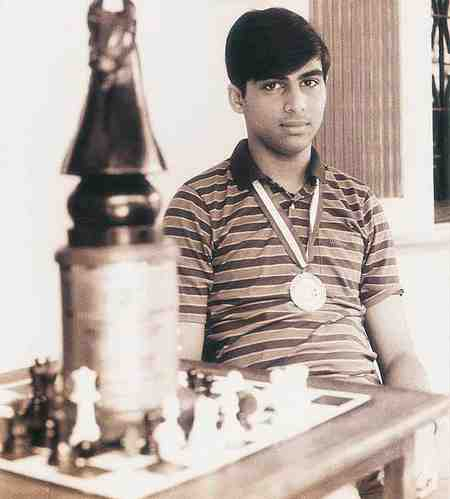
A young Viswanathan Anand at the beginning of his great journey that would transform modern Indian chess.

Anand at the height of his career, having established himself among the greatest players in chess history.
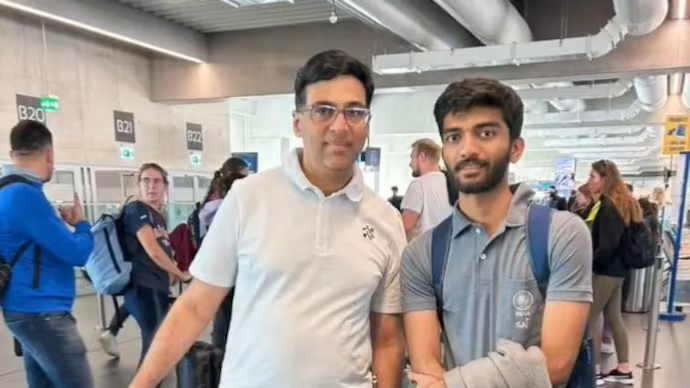
Anand continues to inspire and mentor the generation that followed the path he helped create.
Before Anand, India Dreamed. After Anand, India Believed.
Before India became one of the world’s great chess nations, there was Viswanathan Anand.
When Anand became India’s first Grandmaster in 1988, it was already a historic achievement. But his greatest contribution went far beyond earning a title. Over the next three decades, he would become a five-time World Champion, defeat virtually every great player of his generation, and inspire an extraordinary generation of Indian chess players.
For millions of Indians, Anand was the first proof that an Indian player could stand across the board from the world’s best — and beat them.
He was fast. He was fearless. He was remarkably adaptable. And throughout his career, he carried himself with a quiet humility that became as much a part of his identity as his chess.
That is why Anand is not simply one of India’s greatest chess players.
He is the architect of modern Indian chess.
The First Teacher and the Lightning Kid
Anand’s journey began in Chennai, where his mother, Susila Viswanathan, introduced him to chess when he was six years old.
There were no online platforms, databases or powerful engines to accelerate a young player’s progress. Learning came from books, magazines, puzzles and, most importantly, from curiosity.
His mother copied chess positions and puzzles from magazines and worked through them with him. That early environment helped develop something that would become one of Anand’s defining characteristics: the ability to see and calculate quickly without losing the joy of the game.
Soon, his extraordinary speed of play became impossible to ignore.
He earned the nickname “The Lightning Kid.”
But speed alone doesn’t create a World Champion. Anand’s real strength was the combination of speed, calculation, intuition and an extraordinary ability to understand what a position demanded.
In 1988, that development reached a historic milestone.
At just 18 years of age, Anand became India’s first Grandmaster.
It was more than a personal achievement.
It was a signal.
Indian chess had arrived.
From Challenger to Champion
Anand’s journey to the World Championship was not an overnight success. After becoming India’s first Grandmaster in 1988, he steadily established himself among the world’s elite, competing against the strongest players of his generation.
The 1990s brought Anand into direct battles with the established champions of the era. He challenged Garry Kasparov for the World Championship in 1995 and later faced Anatoly Karpov in 1998. Although neither attempt ended with Anand claiming the title, these matches established him as a genuine contender at the highest level.
Anand kept returning.
His playing style continued to evolve as the chess world changed around him. His extraordinary calculation and speed were complemented by deeper preparation, positional understanding and an ability to adapt to different opponents and formats.
That persistence finally brought its reward in 2000, when Anand won the FIDE World Championship in Tehran.
But becoming World Champion was only the beginning.
He would return to the summit again in 2007, before successfully defending the title against Vladimir Kramnik in 2008, Veselin Topalov in 2010 and Boris Gelfand in 2012.
Across these years, Anand repeatedly demonstrated why adaptability became one of the defining characteristics of his career.
The five games that follow capture different aspects of that greatness.
The Architecture of Greatness: Five Defining World Championship Games
A career as long and successful as Anand’s contains hundreds of remarkable games.
But five encounters stand out because they reveal different sides of the champion — his attacking instinct, preparation, resilience, tactical vision and psychological strength.
#1 – Anand vs Alexei Shirov, FIDE World Championship 2000, Tehran
Anand had already challenged for the World Championship twice, against Garry Kasparov and Anatoly Karpov. In Tehran, he finally stood on the brink of his first world title, facing the dangerous Alexei Shirov.
The game began as a sharp Ruy Lopez, with Anand creating early complications on the queenside. After 18.Rxa6!, his rook became highly active, and the subsequent queen exchange led to a complex endgame.
Anand’s technique then took over. His rook penetrated to the seventh rank with 23.Ra7, while the passed c-pawn became a major weapon.
The critical sequence came with 28.c7 Kf8 29.Nxf5! gxf5 30.Rd7, eliminating Black’s bishop and giving Anand’s rook complete activity.
From there, Anand patiently attacked Black’s pawns and gradually improved his position. Moves such as 42.Rxf5 and 44.Rxf6+ showed his ability to convert small advantages into a winning endgame.
Shirov eventually resigned after 64.Kb3.
The Lesson:
- Create a passed pawn, activate your rook, and convert patiently.
- This was not a spectacular attacking victory. It was Anand demonstrating that precise endgame technique could be just as devastating as tactical brilliance.
#2 – Vladimir Kramnik vs Anand, Game 3, World Championship Match, Bonn (2008)
The 2008 World Championship match between Vladimir Kramnik and Viswanathan Anand became a showcase for Anand’s extraordinary preparation. Game 3 was particularly important:
Anand was playing Black and entered the Meran Variation of the Semi-Slav.
Kramnik launched an aggressive attack with 15.Bxb5, followed by 17.g3, but Anand responded with the remarkable 17…Rg4!, bringing his rook into the attack.
The position became highly tactical. After 19.Nxd4 h5 20.Nxe6 fxe6 21.Rxd7, Kramnik had sacrificed material to attack Black’s king.
Anand remained calm, finding 21…Kf8! and gradually neutralising White’s threats.
The critical sequence continued with 22…Rg7 23.Rxg7 Kxg7, after which Anand’s pieces became increasingly active.
His queen, rook and bishop coordinated beautifully against the exposed white king.
The final attack was decisive. After 39.a7 Qc4+ 40.Ka1 Qf1+ 41.Ka2 Bb1+, Kramnik resigned.
The Lesson:
- Preparation gives you confidence, but calculation wins the position.
- Anand did not panic when Kramnik sacrificed material. He trusted his preparation, calculated accurately and turned White’s attacking ambition into a decisive counterattack.
#3 – Vladimir Kramnik vs Anand, Game 5, World Championship Match, Bonn (2008)
After Anand’s victory in Game 3, Kramnik returned to the same Meran Variation of the Semi-Slav in Game 5.
Anand once again demonstrated how deeply he and his team had prepared the opening.
The position became increasingly sharp after 18…f4 and 19…Be7, as Anand pushed White’s pieces back while creating attacking chances of his own.
Kramnik tried to seize the initiative with 27.Re1 and 28.b4, but Anand’s pieces were already extremely active.
The decisive sequence arrived with: 29.Nxd4 Qxd4 30.Rd1 Nf6!
Kramnik’s rook attacks the queen, but Anand has calculated the tactical response.
After 31.Rxd4 Nxg4, Black wins White’s queen and emerges with a decisive advantage.
The game continued only a few moves before Kramnik resigned after 35…fxe3.
The Lesson:
- Don’t calculate your move in isolation — calculate the opponent’s response.
- Kramnik’s 29.Nxd4 looked natural, but Anand had seen the tactical sequence several moves ahead.
- This game perfectly demonstrates the power of preparation combined with calculation: Anand knew the position, recognised the tactical opportunity and executed it without hesitation.
#4 – Veselin Topalov vs Anand, Game 12, World Championship Match, Sofia (2010)
The final classical game of the 2010 World Championship match carried enormous pressure. The score was tied 5.5–5.5, with the title at stake.
Anand, playing Black, chose the Lasker Defence of the Queen’s Gambit Declined. For much of the game, Topalov maintained the initiative, while Anand patiently defended and waited for his opportunity.
The turning point came with 29…e5, followed by the powerful 30…f5. Anand began opening lines around White’s king, and after 31.exf5 e4!, Black’s pieces suddenly became extremely active.
The attack intensified with 33…Rd4, bringing the rook deep into White’s position. Anand then found the striking 38…Rxg4+, continuing to expose the white king.
The decisive sequence followed: 40.Rf8+ Kg7 41.Nf5+ Kh7 42.Rg3 Rxg3+!
Anand sacrificed his rook to destroy White’s defensive structure. After 43.hxg3 Qg4+, the attack became overwhelming, eventually forcing resignation after 56…Qg7.
The Lesson:
- Defence is not always passive.
- Anand absorbed Topalov’s pressure, improved his pieces and waited for the right moment to strike. When the position opened, his defence transformed into a devastating counterattack.
- Stay patient under pressure — the opponent’s attack may eventually create the weaknesses you need to win.
#5 – Anand vs Boris Gelfand, Game 8, World Championship Match, Moscow (2012)
At 42, Anand was defending his World Championship title against Boris Gelfand. After losing Game 7, Anand needed an immediate response.
He delivered one in spectacular fashion.
The game lasted just 17 moves.
Anand launched his attack with 12.g4!, immediately challenging Black’s kingside. After 12…Re8+ 13.Kd1, Gelfand tried to exploit Anand’s exposed king, but Anand had calculated much deeper.
The tactical sequence continued: 13…Bxb1 14.Rxb1 Qf6 15.gxh5 Qxf3+ 16.Kc2 Qxh1 17.Qf2
Anand had sacrificed material to create a devastating attack and expose Black’s queen and king to tactical threats. Despite Black winning material, the position after 17.Qf2 was strategically and tactically hopeless for Gelfand, who resigned.
The game became one of the most memorable short victories of Anand’s World Championship career.
The Lesson:
- When you see a forcing tactical opportunity, calculate it all the way.
- Anand did not allow the previous game’s defeat to make him cautious. Instead, he trusted his calculation, sacrificed material and created threats that Gelfand could not meet.
- Sometimes the best response to a setback is not to play safely — it is to play boldly and make your opponent solve problems immediately.
The Everlasting Legacy
Anand’s greatest contribution to Indian chess cannot be measured by his five World Championship titles or his peak rating of 2817.
His greatest achievement was what happened after people watched him succeed.
A generation of Indian players grew up seeing an Indian Grandmaster competing for the highest honours in the world.
Then they saw him become World Champion.
Then they saw him defend the title against some of the strongest players of the era.
The message was unmistakable:
An Indian player could belong at the very top.
That belief helped change the country’s chess culture.
India today produces Grandmasters, International Masters, elite juniors and world-class women players at a remarkable rate.
The generation that followed Anand did not have to imagine whether Indians could compete with the world’s best.
They had already seen it happen.
The Road Ahead
Anand’s role in Indian chess did not end when he stopped being the undisputed centre of the chess world.
Through the WestBridge Anand Chess Academy (WACA), he has continued to mentor promising Indian players and contribute to the development of the next generation.
Many of India’s young talents are now competing on the international stage.
The relationship is symbolic.
The player who once opened the door for Indian chess is now helping the next generation walk through it.
The Architect of Modern Indian Chess
Viswanathan Anand’s career represents much more than a collection of titles.
He was India’s first Grandmaster.
He became a World Champion.
Then he became a five-time World Champion.
He competed successfully across changing formats, generations and styles of chess.
But perhaps his most important victory happened away from the board.
He changed what Indian chess players believed was possible.
Before Anand, becoming a world-class Indian chess player seemed like an extraordinary dream.
After Anand, it became a pathway.
Today, India’s chess ecosystem is filled with players who grew up watching him, learning from him and believing that the highest level was within reach.
Anand did not merely sit on the throne.
He built the pathway that allowed countless others to follow.