
| Chapter | Chapter Name | Unit | Level | Reading Time |
|---|---|---|---|---|
| BG001 | Know Your Chessboard & Pieces | Basic Guide | Beginner | 4 min |
The Journey Begins
Imagine sitting in front of a chessboard for the very first time. Sixteen pieces stand ready in front of you, your opponent smiles confidently, and someone says, “White to move.” Suddenly, you realise that you don’t even know where the king belongs or how the knight moves.
Every chess player has experienced this moment.
Whether it is Viswanathan Anand, Gukesh Dommaraju, or Magnus Carlsen, every Grandmaster once learned the same simple rules you are about to discover. They all began with the same 64 squares, the same 32 pieces, and the same dream of becoming a better player.
Chess is more than just a board game. It teaches patience, discipline, planning, creativity, and decision-making. Every move has a purpose, every mistake has a consequence, and every game tells a different story.
This book is designed to help you understand chess in the simplest possible way. You won’t be asked to memorise hundreds of opening moves or complicated variations. Instead, you’ll learn the game step by step through practical examples and real positions.
Let’s begin our journey.
Key Takeaways
After completing this chapter, you will be able to:
- Understand the chessboard.
- Set up the pieces correctly.
- Identify every chess piece.
- Know the relative value of each piece.
- Understand the objective of the game.
Understanding the Chessboard
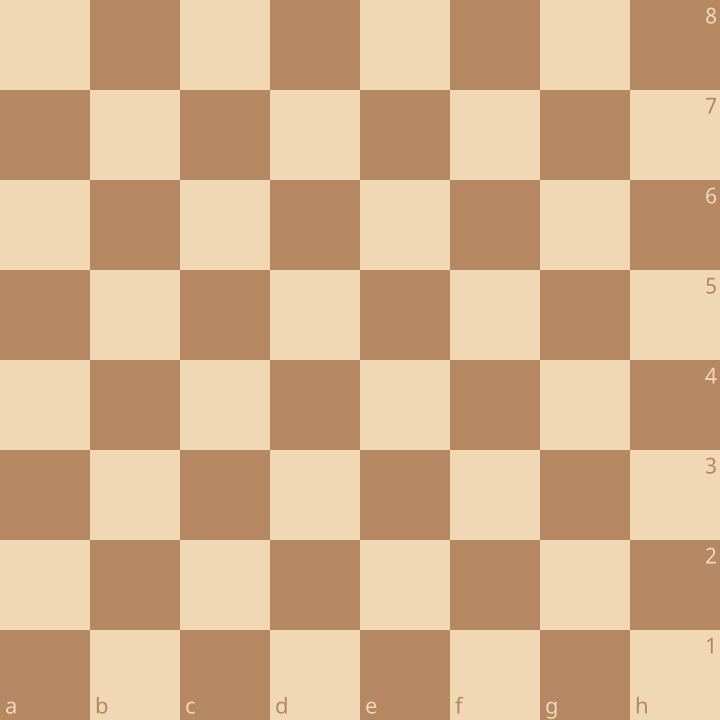
Every chess game is played on a board consisting of 64 squares, arranged in an 8 × 8 grid.
The squares alternate between light and dark colours. The board is divided into:
- 8 Ranks (Horizontal Rows)
- 8 Files (Vertical Columns)
- Diagonals (Slanting lines used mainly by bishops and queens)
One of the most common beginner mistakes is placing the board incorrectly.
Remember this golden rule: “Light Square on the Right.”
If the square in the bottom-right corner isn’t light-coloured, rotate the board before setting up the pieces.
Every square has its own name. For example: e4, d5, h8, a1
These names are called coordinates, allowing players worldwide to record and discuss games accurately.
Meet Your Army
Each player begins the game with 16 pieces.
| Piece | Quantity | Value |
|---|---|---|
| King | 1 | Priceless |
| Queen | 1 | 9 |
| Rooks | 2 | 5 |
| Bishops | 2 | 3 |
| Knights | 2 | 3 |
| Pawns | 8 | 1 |
A knight placed in the centre can sometimes be stronger than a rook trapped behind its own pawns. Likewise, a bishop controlling a long diagonal may dominate the board despite having the same value as a knight.
Always remember: The activity of a piece is often more important than its numerical value.
Setting Up the Board
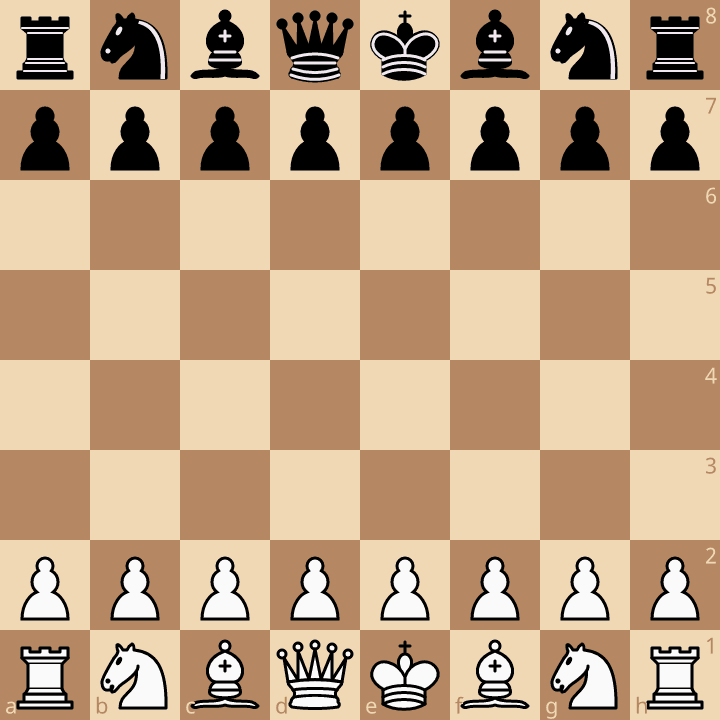
Setting up a chessboard correctly takes less than a minute once you know the pattern.
Follow these simple steps:
Step 1 – Place the board so the light square is on your right-hand side
Step 2 – Place the rooks in the four corners.
Step 3– Place the knights next to the rooks.
Step 4 – Place the bishops beside the knights.
Step 5 – The Queen goes on her own colour. White Queen on the white square. Black Queen on the black square.
Step 6 – The King occupies the remaining square.
Step 7 – Finally, place all eight pawns on the second rank.
Congratulations! Your battlefield is ready.
Key Points to Remember
Before moving on to the next chapter, remember these five important points:
- Chess is played on 64 squares.
- Every player starts with 16 pieces.
- The light square must always be on your right.
- The Queen belongs on her own colour.
- Piece values help us understand exchanges, but activity is often more important than points.
Advice from the Coach
Many beginners are eager to jump straight into famous openings and spectacular checkmates. Resist that temptation.
A strong chess player isn’t created by memorising hundreds of moves. A strong player is built on solid fundamentals. Spend time becoming comfortable with the board, recognising every square, and setting up the pieces without looking at a diagram. These simple habits will save you countless mistakes later.
Remember, every Grandmaster once started exactly where you are today.
Before You Play Your First Game
Can you complete this checklist without looking at a book?
- ✅ Set up the board correctly.
- ✅ Name all six types of chess pieces.
- ✅ Remember the value of every piece.
- ✅ Explain why the King is priceless.
- ✅ Find the squares e4, d5, a1, and h8.
If you answered yes to all five, you’re ready to begin your first chess game.
Did You Know?
- There are 64 squares on a chessboard—32 light and 32 dark.
- Every player starts with 16 pieces, making 32 pieces in total.
- The word “Checkmate” comes from the Persian phrase “Shah Mat,” meaning “The King is helpless.”
- More than 600 million people around the world know how to play chess.
| Next Chapter : BG002 – Build Strong Chess Foundations |