
Introduction
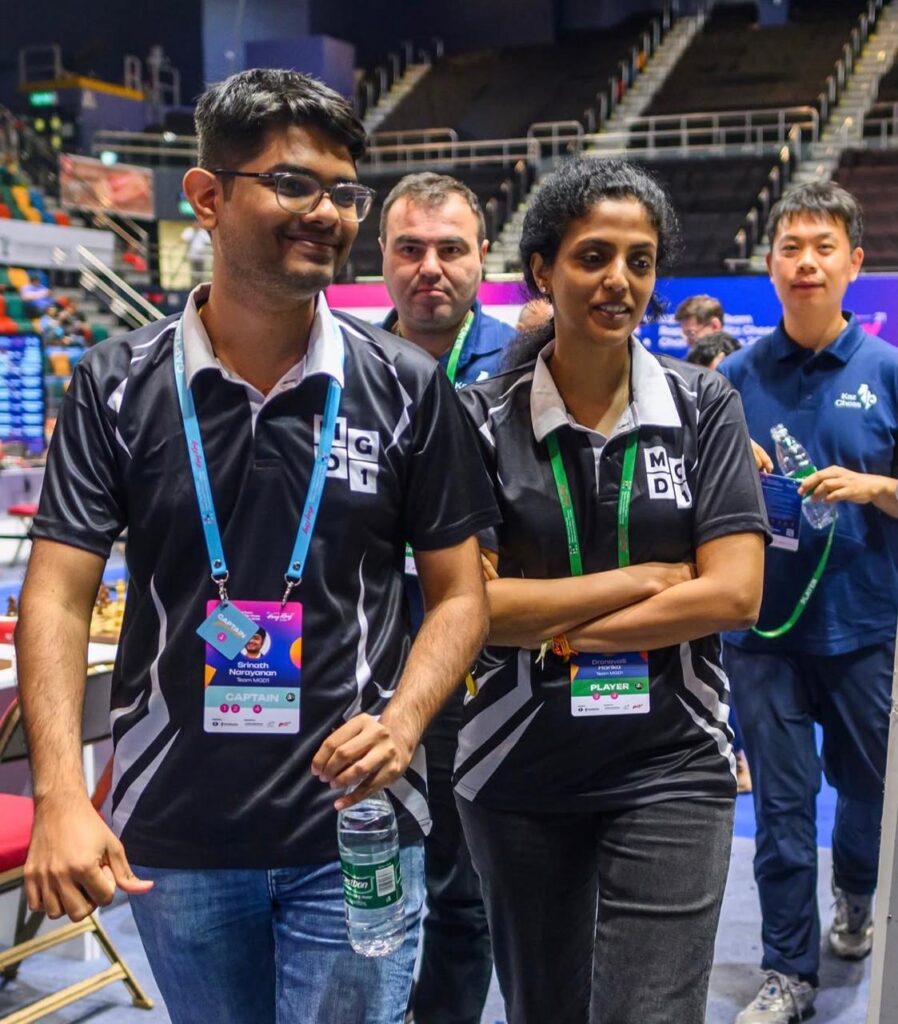
When discussions around the FIDE World Rapid Team Championship 2026 began, much of the attention naturally focused on team standings, elite grandmasters, and the race for medals. Yet among the strongest individual performances of the tournament was the campaign of Indian Grandmaster Harika Dronavalli.
Representing Team MGD1, Harika delivered a remarkably consistent performance against one of the strongest women’s fields assembled in a team event. Her path to an Individual Silver Medal was far from easy. Over twelve rounds, she faced former world champions, rising stars, established elite grandmasters, and some of the strongest female players in the world.
What made Harika’s performance particularly impressive was not merely the number of points scored, but the quality of opposition she faced. Victories against experienced and highly rated opponents were combined with resilient draws against some of the world’s best players. More importantly, she demonstrated a balanced approach throughout the event—knowing when to press for victory and when to defend accurately.
In a tournament filled with world-class talent, Harika once again proved why she remains one of India’s most reliable and accomplished chess players.
Harika Dronavalli’s Tournament Performance
| Round | Opponent | Rating | Team | Result |
|---|---|---|---|---|
| 1 | CM Chan Pui Yin Brandon | 1806 | Kidult Chess Academy Hong Kong | Won |
| 2 | GM Zhu Chen | 2260 | Qatar Chess Team | Won |
| 3 | IM Teodora Injac | 2299 | Theme International Trading | Won |
| 4 | WIM Zhao Yunqing | 2008 | Shenzhen Qiyu Chess Club | Draw |
| 5 | IM Lu Miaoyi | 2287 | Chessnut Nova | Won |
| 6 | GM Aleksandra Goryachkina | 2499 | WR Chess | Draw |
| 7 | GM Ju Wenjun | 2481 | Dragon Chilling | Draw |
| 8 | GM Bibisara Assaubayeva | 2439 | Kazchess | Lost |
| 9 | GM Divya Deshmukh | 2416 | Hexamind Chess Team | Draw |
| 10 | GM R Vaishali | 2387 | Chessgurukul | Draw |
| 11 | GM Zhu Jiner | 2479 | Endgame.AI | Draw |
| 12 | IM Alua Nurman | 2291 | Barys | Draw |
Please check all the games on Lichess.
Top 5 Games
Opening: Réti Opening / King’s Indian Attack Structure (A07)
One of Harika’s finest victories of the tournament came against former Women’s World Champion Zhu Chen. The game was not decided by a tactical combination but by superior positional understanding, patience, and precise endgame technique.
The critical moment arrived on 8.d5!, when Harika fixed the centre and restricted Black’s counterplay. After exchanging on f3, White accepted a damaged pawn structure with 9.exf3, gaining the bishop pair and long-term central control in return. The move 11.f4! further challenged Black’s kingside ambitions and prevented an easy expansion with …f4.
The middlegame was a battle of manoeuvres. Harika repeatedly improved her pieces with Bh3, Bd2, Be1, and Na4, while Zhu Chen spent valuable time shuffling her bishop between a3 and b4. The decisive breakthrough came with 47.d6! followed by 49.d7!, creating an unstoppable passed pawn that completely tied down Black’s pieces.
From a technical perspective, the game teaches an important lesson: strong players often win by gradually improving their position rather than searching for immediate tactics. Harika identified the long-term weakness in Black’s structure, created a dangerous passed pawn, activated her rook on the seventh rank, and converted the advantage with exemplary precision under severe time pressure. The final mating threat with 54.Rb8+ forced resignation and completed a masterclass in strategic chess.
Key Lesson:
Patience wins games. Improve your pieces, restrict your opponent’s counterplay, and trust that long-term advantages—such as the bishop pair and a passed pawn—will eventually decide the game.
Opening: Réti Opening (A10)
Harika’s victory against rising Chinese star Lu Miaoyi was one of the defining moments of her silver-medal campaign. The game showcased her strategic patience, excellent piece manoeuvring, and composure under extreme time pressure, with both players operating on mere seconds in the final phase.
The opening followed a Réti structure where Black advanced with 6…d4, gaining space but allowing White clear long-term targets. Harika’s 9.Ne5! was an important positional decision, placing the knight on an active outpost and challenging Black’s central control. The manoeuvre Na3-c2-b4-d5 later became a recurring theme, highlighting the value of well-placed knights in closed positions.
The critical moment arrived with 26.Bc6!, an excellent exchange sacrifice of activity for structural gains. After 26…Bxc6 27.bxc6, White created a dangerous passed c-pawn and permanently restricted Black’s queenside coordination. Harika then shifted her focus to the kingside, using Qg4-f5-h7 to create mating threats while simultaneously controlling Black’s counterplay.
The decisive tactical sequence began with 36.Nf4!, followed by 37.Qg6+, 39.Ne7+, and 40.Nf5!, forcing Black into a passive defensive setup. With only one second remaining, Harika calmly played 41.Rb1, activating her final piece and creating unavoidable threats, leading to Lu Miaoyi’s resignation.
Key Lesson:
Strong players understand when to transform positional advantages into tactical opportunities. Harika first improved her pieces, created a passed pawn, restricted Black’s activity, and only then launched her decisive kingside attack. Patience and piece coordination often matter more than immediate aggression.
Opening: Philidor Defence: Exchange Variation (C41)
Harika’s draw against former Women’s World Championship challenger Aleksandra Goryachkina was one of her most mature defensive performances of the tournament. Facing a higher-rated opponent with the white pieces, Harika neutralized White’s initiative early and demonstrated excellent endgame technique.
The critical strategic decision came on 7…Kxd8, willingly entering a queenless middlegame. While Black loses castling rights, the king becomes surprisingly active in the centre, and the position remains completely sound. Harika followed classical principles with …Be6, …Nd7, and …f6, building a solid pawn structure and limiting White’s attacking chances.
The tactical moment of the game occurred after 15…Nxc4!, when Harika exchanged a knight for the active bishop pair. Following 18…Bd6 and 19…Kxd6, Black equalized comfortably and transitioned into a balanced rook endgame. The move 24…Rf8 was particularly instructive, activating the rook immediately instead of remaining passive.
The endgame showcased excellent practical judgment from both players. Harika centralized her king with 26…Kd6 and created queenside counterplay with 28…b5, ensuring that White could not generate a passed pawn. After the knight exchange on move 29, neither side possessed realistic winning chances, and perpetual checks with …Rd1+ secured the draw.
Key Lesson:
Activity is often more important than structure in queenless positions. Harika demonstrated that an active king, centralized rook, and timely pawn breaks can completely neutralize White’s opening advantage. Strong defenders do not merely hold worse positions—they create enough counterplay to make equality inevitable.
Opening: Réti Opening (A10)
Harika’s draw against reigning Women’s World Champion Ju Wenjun was a textbook example of practical decision-making and defensive precision at the highest level. Rather than seeking complications, Harika chose a balanced approach, ensuring active piece play and minimizing long-term weaknesses.
The opening followed a symmetrical Réti structure, with both players developing naturally before entering a dynamic middlegame. The critical sequence began with 17.Qxa3!, where Harika accepted a temporary material imbalance to gain activity and queenside pawns. After 20.Qxa7 and 21.Qxb7, White emerged with two extra pawns, but Black’s active rooks provided sufficient compensation.
The game then transitioned into a rook endgame after 23.Qxa6 Rxa6, where Ju Wenjun demonstrated why active rooks are often more valuable than material advantages. Harika responded accurately, centralizing her king with 28.Kg2 and creating counterplay on the queenside with 27.b4!, preventing Black from generating a passed pawn.
The final position, reached after 30…Rb5, was completely balanced. Both players had active rooks, healthy pawn structures, and no realistic winning chances, leading to a well-deserved draw.
Key Lesson:
Against elite opposition, activity is often more important than material. Harika’s willingness to simplify into an equal rook endgame and maintain active piece play demonstrates a fundamental principle of practical chess: sometimes securing a valuable half-point is the best tournament decision. Strong players know when to press for victory and when to neutralize risks to preserve their overall standing.
Opening: Réti Opening (A10)
Harika’s draw against Zhu Jiner in the penultimate round was a critical result in her pursuit of the Individual Silver Medal. Facing one of China’s strongest young grandmasters, she demonstrated excellent positional judgment and impressive endgame technique under severe time pressure.
The opening followed familiar Réti structures, with both players opting for harmonious development rather than sharp theoretical battles. A key strategic moment came with 19.Bxa8!, where Harika exchanged her bishop for Black’s active rook, simplifying the position and heading toward an equal endgame. The subsequent sequence of 23…Rxd1 and 27…Qxd6 liquidated into a knight ending, placing greater emphasis on piece activity and pawn structure.
The most instructive phase began after 29.Nc8!, a powerful knight manoeuvre that targeted Black’s queenside pawns. Harika won material with 31.Nxb6 and later captured another pawn with 34.Nxe6, but Zhu Jiner’s active king and knight provided sufficient counterplay. The move 44…g5! was particularly important, creating kingside imbalances and preventing White from converting her extra pawn advantage.
The final tactical sequence occurred after 50.e5!, when Harika attempted to create a dangerous passed g-pawn. Although 53.g7 looked threatening, Black’s precise defensive resource 53…Ne7! neutralized the promotion threats and steered the game into a theoretically drawn ending.
Key Lesson:
Knight endgames are often decided by activity rather than material count. Harika showed the importance of active knight manoeuvres and creating passed pawns, while Zhu Jiner demonstrated equally strong defensive technique by centralizing her king and blockading White’s pawn majority. In practical chess, converting a small advantage requires both precision and time management, especially in rapid formats.
What Made Harika’s Performance Special?
Three themes appeared throughout the tournament.
First was consistency. Harika lost only one game despite repeatedly facing elite opposition.
Second was risk management. She rarely forced matters unnecessarily and consistently chose practical solutions.
Third was experience. Many younger players rely heavily on preparation and tactics, whereas Harika repeatedly demonstrated deep positional understanding and excellent endgame judgement.
These qualities allowed her to remain near the top of the standings from start to finish.
The Road Ahead
Harika’s silver-medal performance was another reminder of her enduring class and importance to Indian chess.
While India’s new generation continues to attract headlines, Harika remains one of the country’s most dependable performers on the international stage. Her ability to compete successfully against world champions, rising stars, and elite grandmasters shows that experience remains a powerful asset in modern chess.
The FIDE World Rapid Team Championship 2026 highlighted many memorable performances, but Harika’s campaign stands out for its consistency, resilience, and professionalism. Every victory mattered, every draw had value, and together they produced an Individual Silver Medal against one of the strongest fields in the event.
For club players, the biggest lesson from Harika’s tournament is simple: success is not always built on brilliant attacks or spectacular sacrifices. More often, it comes from making good decisions repeatedly over many rounds.
That is exactly what Harika Dronavalli did in Hong Kong.