
Introduction
The FIDE World Rapid and Blitz Team Championships 2026 in Hong Kong featured some of the biggest names in world chess, with much of the attention focused on elite grandmasters and the battle for team medals.
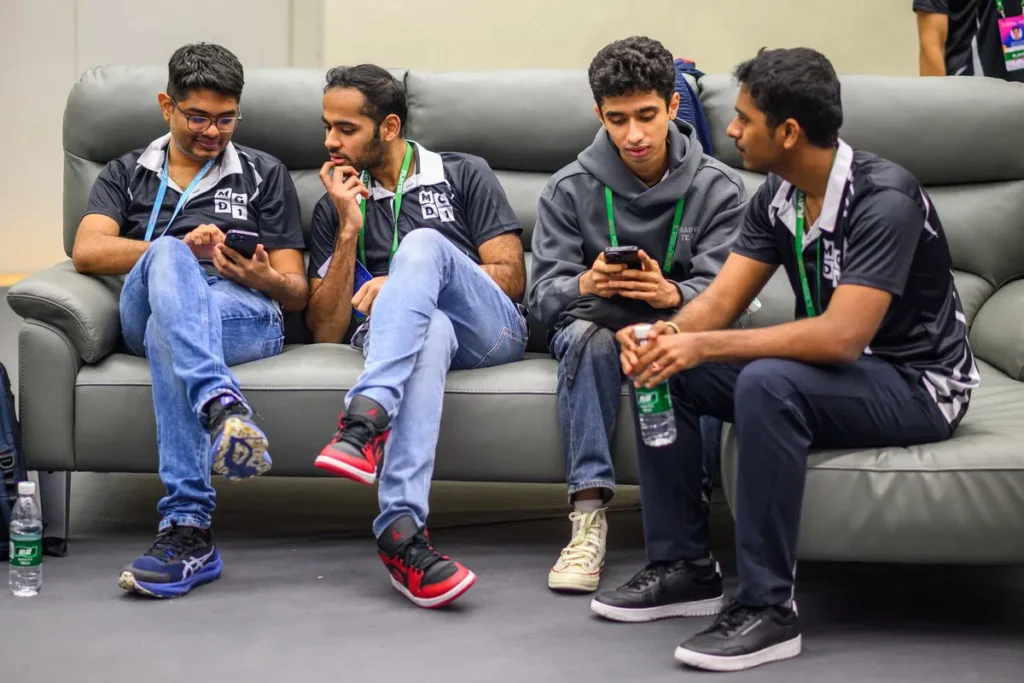
However, Team MGD1’s impressive run to the silver medal in the Rapid Championship was not built solely on performances from its top boards. One of the key contributors was Aryan Abhijeet Shah, who represented MGD1 on the mandatory amateur board alongside Arjun Erigaisi, Nihal Sarin, Leon Luke Mendonca, Abhimanyu Puranik, Harika Dronavalli, and Pranav Venkatesh.
Aryan delivered an outstanding performance, scoring 10.5 points from 12 games and earning the individual silver medal in the amateur category. His consistency and ability to convert critical positions played an important role in MGD1’s success throughout the tournament.
This report analyses Aryan’s rapid campaign round by round, highlighting key moments, critical decisions, and practical lessons from each game.
Opening : Rapport-Jobava System (D01)
Result: 1-0
Aryan began his FIDE World Rapid Team Championship campaign with an impressive victory over Xia Xuejing of Kidult Chess Academy Hong Kong.
Opting for the dynamic Rapport-Jobava System (1.d4 d5 2.Nc3 3.Bf4), Aryan immediately steered the game away from conventional Queen’s Pawn structures. The early advance 5.dxc5 followed by 6.Na4 and 7.b4 demonstrated White’s intention to hold the extra pawn and gain queenside space.
The critical phase emerged in the middlegame after Black launched an active central counterattack with …e5, …d4, and …e4. Despite falling behind on the clock—dropping below two minutes by move 17—Aryan remained calm and found practical solutions.
The turning point came after 20.Qa4 and 21.Qxa5, when White successfully neutralized Black’s central passed pawn while collecting material on the queenside. Aryan then transitioned efficiently into a rook endgame with an outside passed b-pawn.
From move 45 onwards, White’s connected passed pawns and active rooks proved decisive. Even in severe time pressure, Aryan maintained excellent coordination and converted the advantage with precision.
A strong start to the tournament, this game highlighted one of Aryan’s key strengths throughout the event: the ability to remain composed in complicated positions and convert small advantages into full points.
Key Lesson:
In rapid chess, practical decision-making often matters more than finding the engine’s first choice. Aryan prioritized activity, neutralized Black’s counterplay, and trusted his endgame technique under time pressure.
Opening: French Defence: Exchange Variation (C01)
Result: 0-1
Aryan continued his strong start to the tournament with a convincing victory over Candidate Master Al-Kuwari Hamad of the Qatar Chess Team.
The game began with the Exchange Variation of the French Defence, a system often associated with symmetrical and quiet positions. However, Aryan quickly transformed the character of the game with the ambitious pawn thrust 6…c4, gaining space on the queenside and establishing a clear strategic plan.
Black expanded further with …b5 and …a5, while White launched an aggressive kingside initiative with f4 and g4. Aryan responded accurately, activating his knight with the manoeuvre …Nh5-g3-e4, creating counterplay in the centre.
The critical moment arrived after 24…f6, when Aryan challenged White’s centre and opened lines for his pieces. Despite operating with less than two minutes on the clock, he found a series of precise defensive moves, including 27…Ra6 and 29…Bd6, neutralising White’s attack.
As the game entered severe time pressure, Aryan demonstrated excellent practical skills. He exploited White’s overextended kingside pawns and converted his queenside majority into a winning advantage.
The decisive mistake came with 43.Bd2+, allowing 43…Nf4+! and the powerful follow-up 44…Qxf4. Once Black’s queen invaded on b8, White’s attack disappeared, and resignation followed shortly after.
This game showcased Aryan’s ability to remain calm under pressure, absorb an attack, and strike back at the right moment.
Key Lesson: In rapid chess, successful defence often depends on counterplay. Rather than passively responding to White’s kingside attack, Aryan created threats on the queenside and in the centre, forcing his opponent to divide attention between attack and defence.
Opening: French Defence: Steinitz Variation (C11)
Result: 0-1
Aryan secured his third consecutive victory with a clinical performance against Zhang Changjie of Theme International Trading.
The game began with the French Defence, where White chose the aggressive and uncommon 5.Qh5, aiming for an early kingside initiative. Aryan responded confidently with the thematic counterplay 5…c5, immediately challenging White’s centre.
The critical moment came after 7.Ng5 g6 8.Qf3, when Aryan seized the opportunity to win a central pawn with 8…Nxe5. White’s ambitious opening setup left the queen misplaced and the kingside underdeveloped, allowing Black to gain both time and initiative.
Aryan continued accurately with …e5, …a6, and quick kingside castling, gradually improving the position of his pieces while restricting White’s attacking chances. By move 17, Black had completed development, while White was struggling with an exposed king and limited coordination.
The decisive breakthrough arrived with the queenside expansion 18…b5 and 19…b4, opening lines and exploiting White’s poorly placed knight. After 20…Bxc2, Black won another important pawn and established a dangerous passed d-pawn.
The final tactical sequence began with 22…d3, followed by the powerful 23…Nd4, creating multiple threats against White’s king and pieces. With only seconds remaining and no satisfactory defence available, White resigned.
Aryan finished the game with more than five minutes on the clock, highlighting another key feature of his tournament performance: efficient time management.
Key Lesson:
Early queen sorties can become a liability if they are not backed by development. Aryan punished White’s premature attack by striking in the centre, completing development quickly, and exploiting the resulting weaknesses with energetic queenside play.
Opening: D01 – Rapport-Jobava System
Result: 1-0
Aryan continued his perfect start with a fourth consecutive victory, defeating Zhou Tony of Shenzhen Qiyu Chess Club in another energetic game with the Rapport-Jobava System.
White adopted an aggressive setup with 5.f3, followed by 6.g4 and 7.h4, immediately gaining space on the kingside and forcing Black’s bishop to retreat. Aryan’s approach was consistent with the spirit of the Jobava System: create imbalances early and dictate the course of the game.
After Black challenged the centre with …c5 and later expanded with …b5, Aryan responded calmly by consolidating his position and improving his pieces. The manoeuvre Nf4-d3 allowed White to maintain control over key central squares while preparing for the middlegame transition.
The critical phase began after 23…e5, when Black sought counterplay in the centre. Aryan reacted accurately by exchanging pieces and simplifying into a favourable position. His decision to activate the rooks on the d-file proved decisive.
The turning point came after 32.e4 d4 33.Rxd4!, a precise tactical sequence that forced multiple exchanges. Following 34…Rdd5, Aryan spotted the key idea 35.Qxe5!, winning Black’s queen and entering a completely winning rook endgame.
Black resigned after 36.Rxe5, with White emerging a full exchange ahead and no practical counterplay remaining.
This game highlighted Aryan’s excellent tactical awareness and his ability to convert dynamic opening pressure into concrete material gains.
Key Lesson:
Aggressive openings create opportunities, but converting those opportunities requires patience. Aryan combined active piece play with timely simplification, demonstrating the importance of transitioning from attack to technique when the position demands it.
Opening: French Defence: Advance Variation (C02)
Result: 0-1
Aryan extended his winning streak to five games with a dynamic victory over Tim Letoret of Chessnut Nova.
The game began with the Advance Variation of the French Defence, where Aryan adopted the ambitious plan of challenging White’s centre with the thematic break 6…f6. After exchanging central pawns, Black castled queenside on move 10, signalling opposite-side attacks and setting the stage for a sharp middlegame.
White attempted to build pressure with active piece play and the advance 13.c4, but Aryan responded energetically with 16…d4, seizing space and restricting White’s pieces. The key strategic idea was clear: attack the kingside while using the advanced d-pawn to support Black’s initiative.
The critical moment came after 24.Rxc5, when White grabbed a pawn on the queenside and underestimated Black’s attacking chances. Aryan immediately launched a decisive kingside assault with 24…Qh2+! followed by the exchange sacrifice 25…Rxf2+!.
After 27…Rxf3+, the position simplified into an endgame where Black’s dangerous passed e-pawn and active queen provided a lasting advantage. Aryan converted accurately, steadily improving his king and advancing his kingside pawns.
Despite White’s stubborn resistance, Black’s queen and g-pawn created unstoppable mating threats. The game concluded with the elegant finish 55…Qh4#.
This was Aryan’s most attacking performance of the tournament so far and demonstrated his excellent understanding of opposite-side castling positions.
Key Lesson:
In positions with opposite-side castling, time is often more important than material. Aryan ignored White’s queenside pawn grab and focused entirely on activating his pieces and attacking the king—a strategy that paid off decisively.
Opening: Scandinavian Defence: Modern Variation (B01)
Result: 1-0
Round 6 presented Aryan with his toughest challenge so far, facing WR Chess—the team featuring several world-class grandmasters on the top boards. Once again, the MGD1 amateur board delivered.
The game began with an unusual Scandinavian setup in which Black developed the queen early with 3…Qxd5 and 4…Qa5. Aryan responded actively, establishing central control and preparing an aggressive kingside expansion with f4 and g4.
The critical moment arrived after 18…Qd7. Spotting a tactical opportunity, Aryan sacrificed the exchange with 19.Rxb6!, opening lines and exploiting the awkward positioning of Black’s queen and rook. The follow-up 20.Nxb6 and 21.Nxa8 left White with a material advantage and long-term pressure.
Although Black recovered some material with 22…Qxa8, Aryan maintained the initiative through superior piece activity and a more dangerous pawn structure.
The game entered a tense rook-and-bishop endgame, where Aryan’s active rook and passed d-pawn became decisive weapons. The breakthrough came with 40.d5 and 41.d6, creating unstoppable threats against Black’s king.
Despite both players having just over a minute remaining, Aryan demonstrated excellent composure and tactical awareness. The game concluded with the elegant checkmate 42.Bc3#.
Defeating WR Chess on the amateur board proved to be a crucial result for MGD1’s overall campaign and highlighted Aryan’s ability to perform under pressure against strong opposition.
Key Lesson:
Material imbalances matter less when one side has greater activity. Aryan’s exchange sacrifice created long-term initiative, active pieces, and dangerous passed pawns—more than enough compensation to justify the investment.
Opening: French Defence: Rubinstein Variation (C10)
Result: ½-½
Round 7 featured one of the most important matchups of the tournament, as MGD1 faced eventual champions Dragon Chilling. On the amateur board, Aryan took on Wang Zihao, who would later claim the individual gold medal in the amateur category.
The game began with the Rubinstein Variation of the French Defence. Aryan adopted a solid setup, exchanging pieces early and steering the game towards a balanced middlegame. White castled queenside and attempted to generate kingside pressure, but Black responded actively with timely central breaks and accurate piece placement.
The critical phase came after 25…e5, when Aryan seized the initiative and activated his queen on the queenside with 27…Qxa2. Despite operating with less than a minute on the clock, he maintained excellent coordination and successfully neutralised White’s attacking chances.
After the queens were exchanged on move 36, the game transitioned into a rook endgame where both players had dangerous passed pawns. White’s advanced e-pawn looked threatening, but Aryan demonstrated precise defensive technique by activating his rook behind the pawn and creating counterplay with his queenside majority.
The resulting rook ending required accuracy from both sides. Aryan patiently improved his king position, activated his rook, and prevented White’s king from supporting the passed h-pawn.
After 93 moves, neither side could make further progress, and the game ended in a well-fought draw.
This result proved significant in the race for the individual amateur-board medal. Wang Zihao eventually secured gold, while Aryan finished just behind him with the silver medal.
Key Lesson: Strong defensive technique is just as important as attacking ability. Aryan successfully held a complex rook endgame by keeping his rook active, creating counterplay, and resisting the temptation to defend passively.
Opening: D02 – Queen’s Pawn Game / Jobava-London Setup
Result: 1-0
Round 8 marked Aryan’s toughest test so far in terms of rating, as he faced Kumar Tyulyupov of KazChess, rated 1892.
Staying true to his opening repertoire, Aryan once again employed the Jobava-London setup with 1.d4, 2.Nc3, and 3.Bf4. The opening led to an unbalanced middlegame where both sides completed development before launching operations on opposite wings.
The game remained relatively balanced through the early middlegame. Aryan manoeuvred patiently, improving his knight via d3-c5-d7-e5 and steadily increasing pressure on Black’s position.
The critical phase began with the energetic pawn break 25.f5. Rather than maintaining the tension, Aryan chose to open lines with 26.fxe6, exposing weaknesses in Black’s kingside structure.
After 27.Qg4 and 28.Qg6, White’s queen infiltrated decisively, creating threats against both the king and the vulnerable f-file. Black struggled to coordinate his pieces and fell into severe time trouble.
The key tactical idea arrived with 29.Nf7!, a powerful knight jump that increased pressure on h6 and g5 while restricting Black’s defensive options.
Although Black attempted to generate counterplay with 29…Bxh2+ and 30…Qh4+, Aryan defended accurately and kept the initiative. After 31.Kg1, Black’s position became extremely difficult to hold.
With no increment left on the clock, Black’s flag fell after 32…Re7, handing Aryan his seventh victory in eight rounds.
This game highlighted one of Aryan’s greatest strengths throughout the tournament: his ability to maintain pressure and force mistakes when opponents entered time trouble.
Key Lesson:
In rapid chess, sustained pressure often proves more effective than immediate tactical blows. Aryan gradually improved his pieces, opened lines at the right moment, and capitalised when his opponent ran short of time.
Opening: French Defence: Tarrasch Variation (C03)
Result: 0-1
Round 9 saw MGD1 face one of their direct rivals, Hexamind Chess Team, in a crucial encounter near the top of the standings. On the amateur board, Aryan delivered another vital victory against Murat Omarov.
The game began with the Tarrasch Variation of the French Defence. Aryan adopted a classical setup, challenging White’s centre with the thematic …c5 break before gradually activating his pieces.
After a series of exchanges in the centre, the game transitioned into a balanced middlegame with queens and rooks still on the board. Aryan’s strategic approach became clear with the moves 18…f6 and 20…Rf7, preparing to double rooks and generate pressure along the central files.
The critical moment arrived after 24.Qg4, when Aryan struck immediately with 24…f5, gaining space and forcing White’s queen onto defensive squares. Black then won a queenside pawn with 25…Qxb2, seizing the initiative.
Despite both players operating with less than two minutes on the clock, Aryan remained remarkably composed. The tactical sequence beginning with 28…Bxg2! demonstrated excellent calculation under pressure. By exchanging rooks and centralising his queen, he transformed his positional advantage into a direct attack against White’s king.
The decisive breakthrough came with 36…f3+!, opening crucial lines around the king. White’s pieces were unable to coordinate defensively, and the game concluded with the elegant mating pattern 39…Qg2#.
This victory moved Aryan to an impressive 8.5/9 and underlined his importance to MGD1’s medal challenge.
Key Lesson:
In queen middlegames, activating the queen and creating multiple threats often outweighs material considerations. Aryan combined active piece play with precise tactical execution, converting a small advantage into a decisive kingside attack.
Opening: D02 – Queen’s Pawn Game / Jobava-London Setup
Result: 1-0
Entering Round 10 with an unbeaten score of 8.5/9, Aryan faced Vishruth B of ChessGurukul in another crucial match for MGD1’s medal ambitions.
Once again, Aryan relied on his trusted Jobava-London setup with 1.d4, 2.Nc3, and 3.Bf4. The opening led to a complex middlegame where both players castled on opposite wings and launched attacks against each other’s kings.
Black generated active counterplay on the queenside with …b5, …Qxb4, and doubled rooks on the b-file. Aryan responded by improving his pieces and creating threats against Black’s king with the manoeuvre Nf5-e7-c6.
The critical moment arrived after 26.Ne7+ Kh8 27.Nc6, when Aryan forced Black into a tactical sequence involving a rook sacrifice on b2. Although Black won material and generated checks against the exposed white king, Aryan remained composed and accurately calculated the resulting queen-and-rook endgame.
With both players under severe time pressure, Aryan demonstrated excellent practical decision-making. The key breakthrough came with 42.gxh6!, followed by 43.hxg7+, opening lines around the black king and simplifying into a winning rook endgame.
Aryan’s active rook and dangerous passed a-pawn ultimately proved decisive. The pawn marched all the way to promotion on move 56, and Black resigned one move later in a hopeless position.
This hard-fought victory moved Aryan to an outstanding 9.5/10 and kept MGD1 firmly in contention for the team medals.
Key Lesson:
Passed pawns are strongest when supported by active pieces. Aryan combined precise defence with energetic rook activity, transforming his outside passed a-pawn into a decisive winning weapon.
Opening: French Defence: Exchange Variation (C01)
Result: 1-0
Entering the penultimate round with an outstanding score of 9.5/10, Aryan faced Nguyen Anh Dung of Endgame.AI in a crucial encounter for both the individual amateur-board standings and MGD1’s pursuit of a team medal.
The game began with the Exchange Variation of the French Defence. White opted for an early queen exchange with 8.Qe2+ and 9.Qxe7+, steering the game into an endgame-oriented position where piece activity and long-term planning took precedence over tactical complications.
Aryan adopted a queenside expansion plan with …b5 and …a5, while White gradually improved piece coordination and targeted the central dark squares. The position remained balanced for much of the middlegame, with both players manoeuvring carefully.
The critical phase began with 25…f6, when Aryan challenged White’s centre and sought active counterplay. Following a series of exchanges, the game transitioned into a double-rook endgame where White’s pieces proved slightly more active.
Despite operating with less than a minute on the clock, Aryan continued to create practical chances. The passed c-pawn generated counterplay, while the rooks remained active on the second rank. However, White maintained control of the position and gradually improved the king and rook coordination.
The decisive moment came after 65.f5, when White created a dangerous passed pawn and forced Black into passive defence. Although Aryan fought resourcefully until the end, White converted the advantage with precise endgame technique.
This defeat ended Aryan’s remarkable unbeaten run, but he still entered the final round with an exceptional score of 9.5/11, firmly in contention for an individual medal and playing a pivotal role in MGD1’s silver-medal campaign.
Key Lesson:
Endgames are often decided by activity rather than material. Even in difficult positions, Aryan continued to seek counterplay with active rooks and passed pawns—a practical approach that remains essential in rapid chess.
Opening: D00 – Jobava-London System
Result: 1-0
Entering the final round, Aryan needed a strong finish to secure an individual medal and help MGD1 strengthen its position in the race for team honours. Facing the higher-rated Ailin Zarkym of Barys, he delivered one of his most mature performances of the tournament.
Once again, Aryan trusted his trademark Jobava-London setup with 1.d4, 2.Nc3, and 3.Bf4. Rather than seeking immediate complications, he opted for a long-term strategic approach, gaining space on the queenside with 9.b4 and 10.a5.
After the exchange of dark-squared bishops, the game evolved into a manoeuvring battle. Aryan steadily improved his pieces, transferring his knight to the strong c5 outpost and doubling his heavy pieces on the e-file.
The critical phase began with 32.g4, followed by the aggressive advance 33.h5. These moves restricted Black’s kingside and created long-term weaknesses around the king.
Despite increasing time pressure, Aryan maintained complete control. The breakthrough came with 35.fxg5+ and 37.gxf5, opening lines against the exposed black king. Black’s pieces struggled to coordinate, while White’s rook became increasingly active on the seventh rank.
The decisive moment arrived with 39.Re7+, forcing the black king into a passive position. After 40.Qf4 and 41.Qe5, White created multiple threats against the king and the vulnerable f5-pawn.
With less than a minute remaining and no satisfactory defence available, Black resigned.
This victory secured Aryan an outstanding score of 10.5/12, capping off a remarkable tournament in which he remained unbeaten against every opponent rated below 1900 and defeated a higher-rated player in the final round.
More importantly, his contribution proved instrumental in MGD1’s silver-medal finish at the FIDE World Rapid Team Championship.
Key Lesson:
Strategic pressure often creates tactical opportunities. Aryan patiently improved his pieces, restricted his opponent’s counterplay, and only opened the position once all his pieces were optimally placed.
Conclusion: The Rise of a Reliable Match Winner
Aryan Abhijeet Shah finished the FIDE World Rapid Team Championship 2026 with an outstanding score of 10.5/12, recording 10 wins, 1 draw, and just 1 loss.
Representing MGD1 on the mandatory amateur board, Aryan consistently delivered crucial points against strong opposition, helping his team secure the silver medal in one of the strongest team events on the calendar.
A closer look at his games reveals several recurring themes:
- Effective use of the Jobava-London System as White
- Confident handling of multiple French Defence structures as Black
- Strong practical decision-making under time pressure
- Excellent conversion of small advantages
- Active defensive technique and counterplay in difficult positions
Perhaps the most impressive aspect of Aryan’s performance was his consistency. While attention naturally focused on elite grandmasters, MGD1’s success was built equally on the reliability of its amateur board.
At just 1932 Elo entering the tournament, Aryan delivered a performance far above his rating and demonstrated the qualities of a player ready for stronger opposition.
The challenge now is to build on this momentum. If this event is any indication, Indian chess may have discovered another dependable performer capable of thriving on the international stage.
For aspiring players, Aryan’s tournament offers a simple lesson:
Strong openings create opportunities, but practical decision-making wins games.
Related Articles:
- Harika Dronavalli’s Silver Medal Run at the FIDE World Rapid Team Championship 2026
- From Rapid Silver to Blitz Top-6: MGD1’s Remarkable Journey at the FIDE World Team Championships 2026
- Arjun Erigaisi Leads MGD1 to Silver at FIDE World Rapid Team 2026