
Chapter 1
Middlegame Mastery
MG001
INTERFERENCE
Cut the Connection. Win the Position.
Interference is a tactical motif where a piece is placed between two enemy pieces, breaking a line of communication between them.
The important point is that you are usually not attacking the target directly.
Instead, you attack the relationship between two pieces.
Imagine a rook that is protected by a bishop along a diagonal. The rook may appear completely safe. But if you can place one of your pieces between the bishop and the rook, the protection disappears.
Suddenly, the rook is hanging.
That is Interference.
The motif can work in many different situations:
Defender → [Interfering Piece] → Target
Once the connection is broken, the target can become vulnerable.
Key Takeaways
- Interference means deliberately placing a piece between two enemy pieces to disrupt their line of communication.
- The tactic is especially powerful against rooks, bishops and queens, whose defensive power depends on open lines.
- The target is often not the defended piece itself, but the connection between the defender and its target.
- An interfering move can win material, allow a pawn to promote, create a decisive attack or even lead to checkmate.
- Before making a move, ask yourself: “Can I cut off my opponent’s defender?”
Practical Examples
Example 1 – Breaking the Defensive Line
This position is a classic illustration of the Interference tactical motif. Black’s rook on b3 appears to be safely defended by the bishop on f7, making it difficult for White to win material directly. However, White recognizes that the rook’s safety depends entirely on the bishop maintaining its line of defense. Instead of attacking the rook immediately, White first aims to break the connection between these two pieces.
The brilliant move 1.d5+! achieves this objective perfectly. The pawn advances with check, forcing Black’s king to respond. More importantly, the pawn is placed directly between the bishop and the rook, cutting off the bishop’s line of defense. This is the essence of the Interference tactic—placing a piece between two enemy pieces to disrupt their coordination.
After Black responds with 1…Kd6, the rook on b3 is no longer protected by the bishop. White immediately exploits this with 2.Qxb3, winning the rook without any tactical complications. A seemingly well-defended piece suddenly becomes vulnerable because its defender has been isolated.
This example teaches an important lesson: before launching a direct attack, examine whether your opponent’s pieces rely on a line of communication for protection. By interfering with that line, you can often turn a defended piece into an easy target and gain a decisive material advantage.
Solution: 1.d5+! Kd6 2.Qxb3 +-

Example 2 – Blocking the Attack
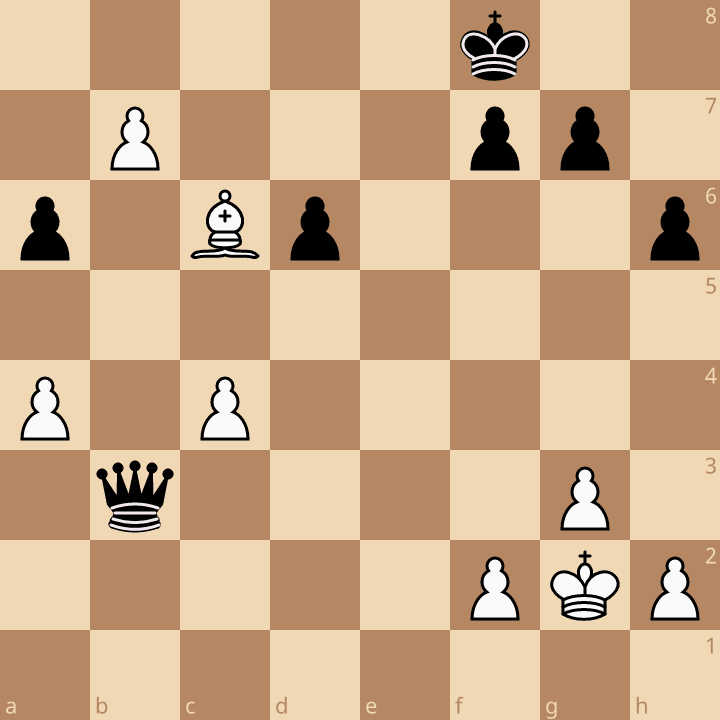
This position demonstrates how the Interference tactic can be used to support pawn promotion. White’s passed b-pawn is only one move away from reaching the eighth rank and becoming a queen. However, Black’s queen on b3 is perfectly placed to stop the promotion by controlling the promotion square. A direct advance of the pawn would simply fail, so White must first break the queen’s line of attack.
The brilliant move 1.Bb5! achieves exactly that. White places the bishop between the Black queen and the promotion square, interfering with the queen’s line of control. Black’s best response is 1…axb5, capturing the bishop. Although White sacrifices a valuable piece, the bishop has already fulfilled its purpose by cutting off the queen’s influence at the critical moment.
With the line blocked, White immediately continues with 2.b8=Q+, successfully promoting the pawn to a queen with check. The newly promoted queen not only restores the sacrificed material but also gives White a decisive advantage.
This example illustrates that Interference is not always used to win material or deliver checkmate. It can also be employed to remove a crucial defensive line, allowing an important strategic objective—such as pawn promotion—to be achieved. Before advancing a passed pawn, always consider whether you can interrupt your opponent’s line of defense with an interfering move.
Solution: 1.Bb5! axb5 2.b8=Q+ +-
Summary
- Interference is about breaking a connection.
- When an enemy piece is protected through a line, don’t automatically attack the protected piece. First ask whether you can place something between the defender and its target.
- A single move can turn:
- Protected → Unprotected
- Defended → Vulnerable
- Stopped → Promoting
- Your question before every tactical move: “Can I cut the line?”
- That’s the habit this chapter is designed to build.
Before You Play Your Next Game
Ask yourself:
- ✅ Which piece is defending the target?
- ✅ How is it defending?
- ✅ Can I block that line?
- ✅What happens after the line is blocked?
That is the thinking process behind Interference.
Advice from the Coach
- Don’t look only at the pieces. Look at the connections between them.
- A strong tactical player learns to see the invisible lines that hold a position together.
- When you identify a defender, don’t stop there. Ask: “What happens if I cut this defender off?”
- Sometimes the winning move isn’t an attack on the piece.
- It’s a move that makes the piece lose its protection.
Did You Know?
- The word Interference describes the tactical idea very literally: one piece gets in the way of another.
- Unlike a direct attack, the interfering piece may not even be interested in capturing anything. Its job is simply to interrupt the communication between two enemy pieces.
- That makes Interference particularly powerful in positions involving long-range pieces such as queens, rooks and bishops.